Choosing between a Beni Ourain and a Boujaad rug is one of the most common dilemmas in Moroccan rug buying. While both are hand-knotted Berber rugs from the Atlas Mountains, they differ dramatically in design, color, texture, and cultural origin.
> Comparison at a glance: Beni Ourain rugs are characterized by cream or ivory backgrounds with minimal geometric diamond motifs in brown or black. Boujaad rugs are bold, colorful, and densely patterned with abstract symbols in reds, oranges, pinks, and warm earth tones. A vintage Boujaad typically contains 2-3x more colors than a Beni Ourain.
What Makes Beni Ourain Rugs Unique?
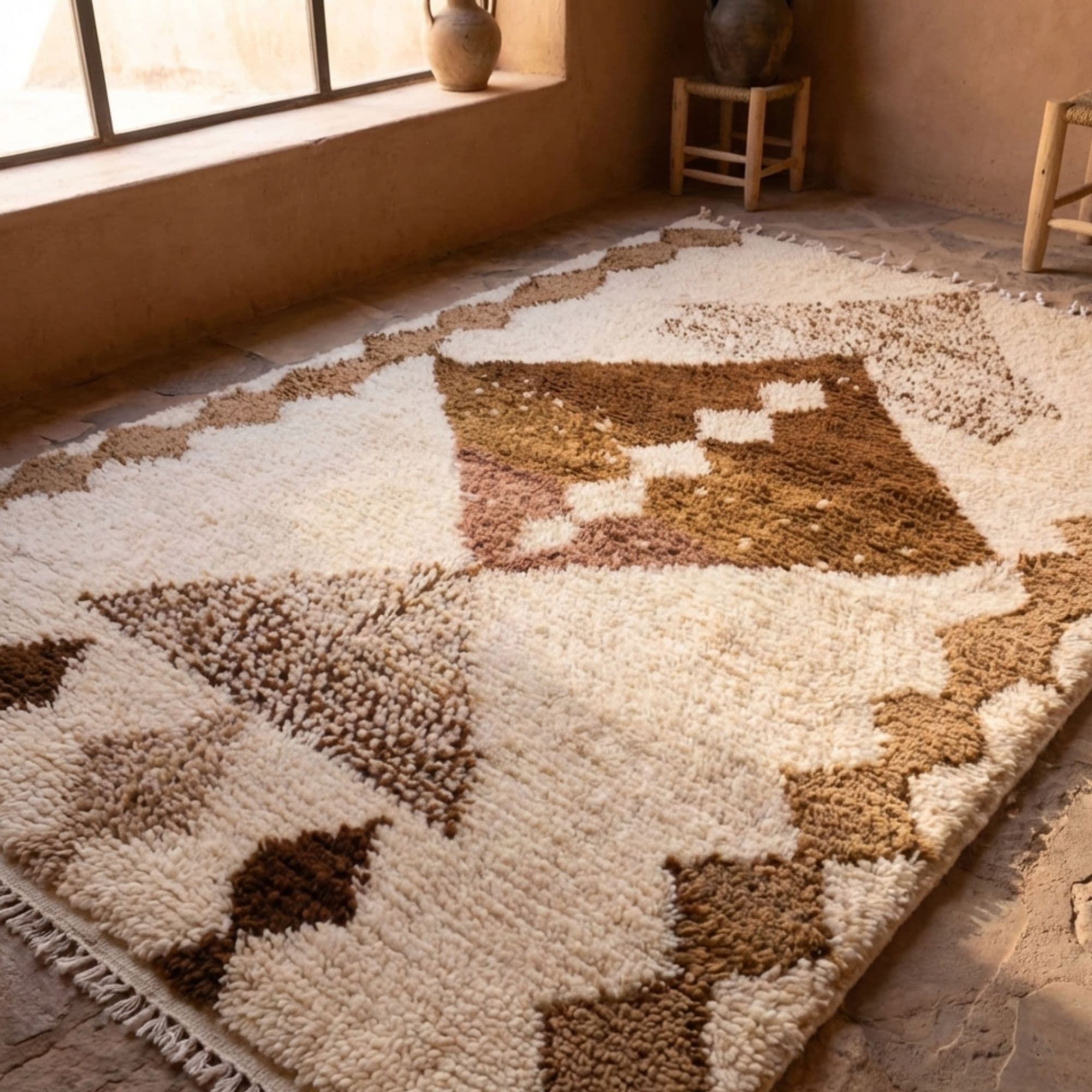
Beni Ourain rugs are the most internationally recognized Berber rug style. Woven by the Beni Ourain tribe in the Middle Atlas Mountains of Morocco, these rugs are defined by their plush, undyed cream wool base and spare geometric patterns in dark brown or charcoal.
A genuine Beni Ourain uses only natural highland sheep wool — no synthetic fibers, no chemical dyes. The cream color comes from the natural undyed wool of local sheep. The dark motifs use wool dyed with walnut husks or iron-rich mud. Each large rug (8x10 ft) contains 8-12 kg of wool and takes 2-4 months to complete, with approximately 150,000 hand-tied knots per square meter.
Beni Ourain rugs, like the ivory Berber rug with charcoal geometric style, are prized in minimalist and modern interiors. Their neutral palette and restrained geometry complement Scandinavian, mid-century modern, and Japandi design styles without competing for attention.
What Defines a Boujaad Rug?
Boujaad rugs originate from the Boujaad region in central Morocco. Unlike the restrained minimalism of Beni Ourain rugs, Boujaad rugs are exuberant, colorful, and dense with symbolic imagery. They feature vibrant shades of red, coral, orange, pink, and terracotta, punctuated by abstract symbols that tell the weaver's personal story.
The bold palette comes from natural plant dyes — madder root for reds, pomegranate for oranges, and saffron for yellows. A pink Berber rug with soft grid style showcases this vibrant Boujaad palette at its finest. The symbols woven into Boujaad rugs carry specific meanings: diamonds represent femininity and protection, zigzags symbolize water and life's journey, and crosses represent the four elements.
Boujaad rugs have a softer, more supple hand than Beni Ourain rugs because they use a different knotting technique. They work beautifully in bohemian, eclectic, and warm-toned interiors where they can serve as the room's focal point.
Beni Ourain vs Boujaad: Key Differences
Design philosophy: Beni Ourain embraces negative space and restraint. Boujaad celebrates abundance and narrative.
Color palette: Beni Ourain uses 2-3 colors (cream, brown, charcoal). Boujaad uses 5-15+ colors including reds, oranges, pinks, and golds.
Wool feel: Beni Ourain rugs have a thicker, denser pile (12-15 mm). Boujaad rugs are softer and more flexible (8-10 mm pile).
Price range: Every rug starts at $145 USD and scales with size — larger pieces cost more. Both are exceptional value for handmade, one-of-a-kind textile art.
Interior compatibility: Beni Ourain suits minimalist, modern, Scandinavian spaces. Boujaad suits bohemian, eclectic, warm, maximalist interiors.
Knot density: Both styles average 150,000-250,000 knots per square meter, depending on the individual weaver's technique.
Which Style Should You Choose?
Choose a Beni Ourain if your space has neutral walls, wood or concrete floors, and you want a rug that adds texture without dominating the room. For a complete guide to making this decision, explore how to choose an authentic Berber rug. It will anchor a minimalist or modern interior with quiet sophistication.
Choose a Boujaad if you want your rug to be a conversation piece — a vibrant focal point that brings warmth and personality. Boujaad rugs excel in spaces that need color and visual energy.
Browse our Beni Ourain collection and discover pieces that embody refined, minimal luxury. Or explore our handpicked Boujaad and colorful Berber rugs for something bolder.
-(1).jpg&w=2560&q=75)
.jpg&w=2560&q=75)
-(1).jpg&w=2560&q=75)