Few objects in contemporary home decor have achieved the kind of cross-cultural success enjoyed by Beni Ourain rugs. They feel equally at home in a Marrakech riad as in a Copenhagen apartment. They anchor rooms arranged around vintage furniture and others where everything is raw and found. They sit naturally in the loft of a fashion designer just as they do in a mountain house where simplicity is the rule.
Their ascent — from weaving villages in the Atlas Mountains of Morocco to the most coveted interiors in the world — is remarkable and entirely deserved. Beni Ourain rugs are not a passing trend. They embody a tradition, and if interior designers choose them again and again, it is because of their very nature: objects shaped by hand, from exceptional natural materials, by artisans who have passed this knowledge down through generations.
This guide covers everything a serious buyer needs to know about Beni Ourain rugs: their origins, how they are made, how to distinguish authentic pieces from imitations, how to choose the right rug, and why — despite the many copies on the market — they remain an investment truly worth making.
What Is a Beni Ourain Rug?
A Beni Ourain rug is a specific type of handmade Moroccan rug, woven by artisans from the Beni Ourain tribal confederation in the Middle Atlas Mountains of northeastern Morocco.
The name “Beni Ourain” refers to the confederation itself — a group of seventeen Berber tribes whose territory spans a high-altitude region of valleys, cedar forests, and grazing lands between the cities of Fes and Midelt. It is a cold region by North African standards: winters in the Atlas can be harsh, and the rugs produced there were designed with these conditions in mind.
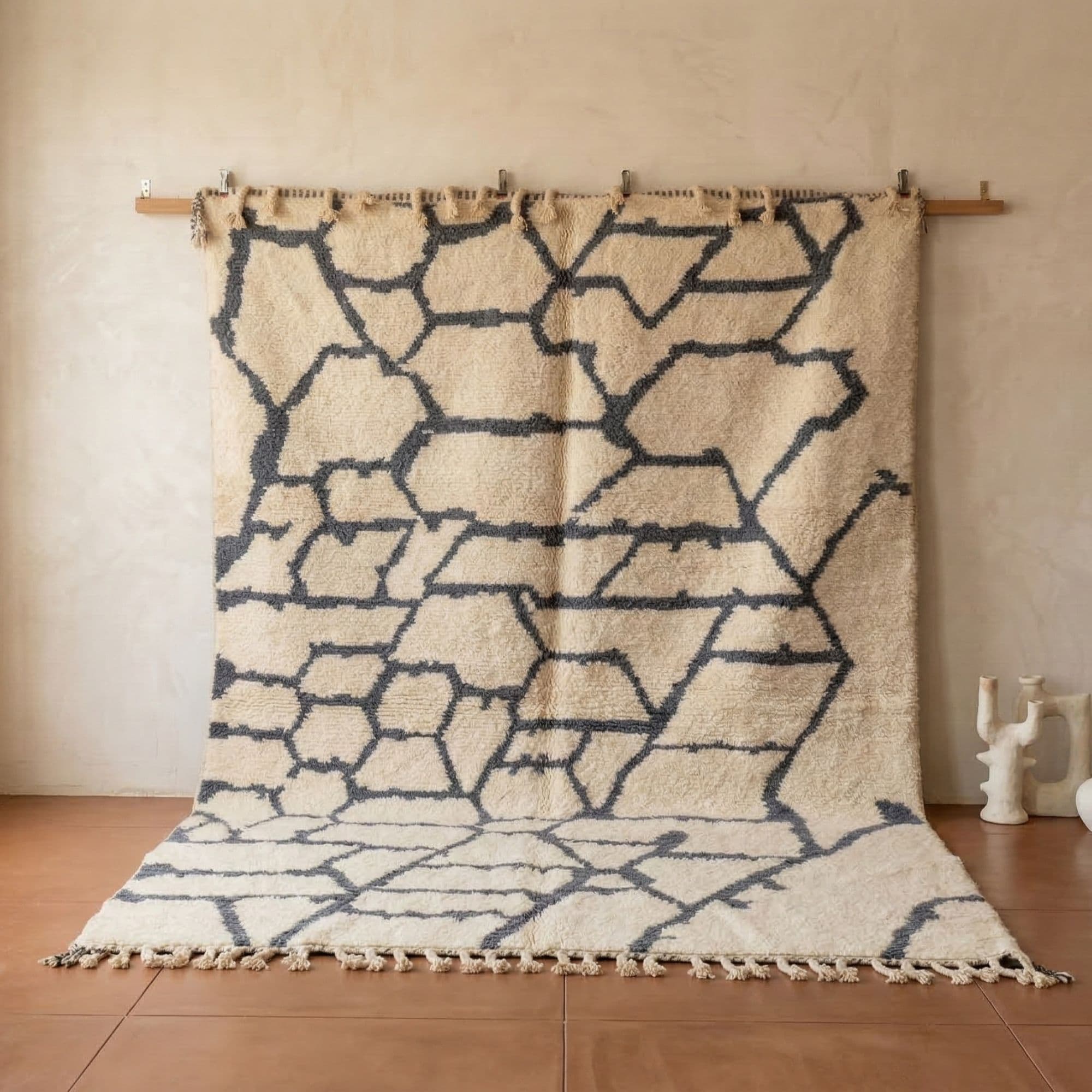
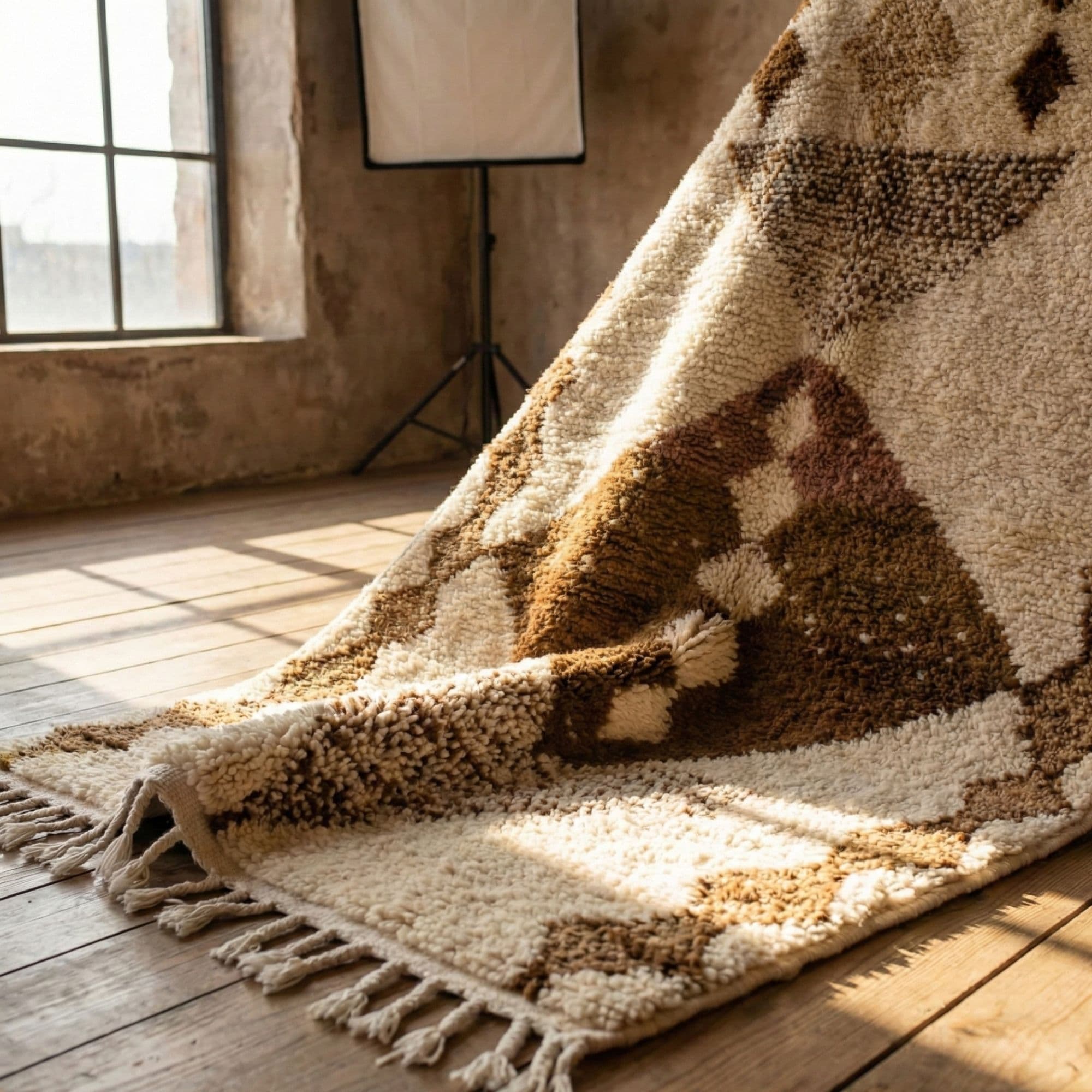
Authentic Beni Ourain rugs are immediately recognizable. They are woven exclusively in undyed natural wool: the cream or ivory color of the fleece serves as the ground, while dark brown or black wool — naturally darker — is used for the patterns. No synthetic dyes, no added color. The motif is geometric: diamonds, zigzag forms, diagonal lines, and abstract shapes unfold across the surface with a unique asymmetrical balance that is the hallmark of human design and execution.
The pile is thick and plush — far more so than most other styles of Moroccan rug — which gives Beni Ourain rugs their characteristic softness underfoot and their distinctive visual depth.
The History of Beni Ourain Rugs
The tribes of the Beni Ourain confederation were, for most of their history, semi-nomadic herders. They moved their flocks between highland pastures in summer and lower valley grazing lands with the seasons, and the rugs woven by their women were primarily practical objects: insulation against cold stone floors, bedding, prayer surfaces, and occasionally outerwear or saddle covers.
The wool came from their own flocks. The looms were simple, vertical, and portable enough to travel with the tribe. The patterns were not mere decorative flourishes but a symbolic vocabulary — a visual language encoding wishes for protection, prayers for fertility, tribal identity, and personal history that had developed over centuries before being written down or catalogued by outsiders.
The discovery of Beni Ourain rugs by the West came relatively late. In the early twentieth century, French ethnologists and colonial administrators documented Berber textile traditions, and a few of these rugs entered European collections. But it was not until the 1950s and 1960s that the international design world truly took notice.
The modernist architects and designers of that era — Le Corbusier among the most famous, though far from the only one — recognized in Beni Ourain rugs a direct echo of their own aesthetic concerns: geometric abstraction, natural materials, the beauty of functional form. A Beni Ourain rug placed on a raw concrete floor was not a contradiction but a harmony. The aesthetic dialogue between Berber weaving and mid-twentieth-century modernism proved extraordinarily fertile, and these rugs have remained highly prized in avant-garde interiors ever since.
For a deeper exploration of this history, see our article on the origins of Beni Ouarain rugs.
What Makes Beni Ourain Rugs Unique?
Natural Wool
The wool used for authentic Beni Ourain rugs comes from Atlas Mountain sheep, a breed adapted over centuries to the cold, arid conditions of the highlands. The result is a fleece naturally rich in lanolin, which gives the finished yarn its warmth, resilience, and subtle luster.
This is not ordinary wool. Industrial wool production prioritizes yield and uniformity; Atlas Mountain wool is prized for qualities that develop more slowly and are harder to quantify. Lanolin gives the pile naturally water-repellent and self-cleaning properties. The fiber structure allows the rug to soften with use rather than wear out. Over the long term, this wool outperforms virtually all alternatives.
Handwoven Craftsmanship
Every authentic Beni Ourain rug is woven by hand, row by row, on a traditional vertical loom. No step is machine-assisted, no shortcuts are taken, and no tufting gun is employed. Each knot is individually tied around the warp threads by a weaver who has dedicated years — often a decade or more — to developing the skill and pattern knowledge required to produce work of exceptional quality.
This is what makes each rug unique. The hands that wove it left their mark: slight variations in knot tension, small shifts in pattern alignment, that organic quality that distinguishes a handmade piece from a mass-produced object.
Minimalist Design
The aesthetic of a Beni Ourain rug is disciplined without being rigid. The palette is limited to two or three tones — cream, ivory, dark brown, and black — and the composition relies on geometric forms rather than figurative or floral motifs. There are no decorative elements in the conventional sense.
This minimalism is not imposed from outside; it reflects the Berber visual tradition, which has always favored geometric abstraction. It also means that Beni Ourain rugs integrate into a remarkable variety of interiors without competing with other elements. They are among the rare statement pieces that, paradoxically, do not demand attention.
Geometric Patterns
The patterns on Beni Ourain rugs are not random. They draw on a rich symbolic vocabulary with deep cultural meaning — more on this below — and are composed with an aesthetic intelligence refined over generations. The geometry is bold without being mechanical: the slight irregularities of handwork give even the most disciplined patterns a living quality, a palpable warmth.
Soft Texture
A Beni Ourain rug offers a distinctly different feel underfoot than other pile rugs. The thickness of the wool, its lanolin content, and the density of its hand-knotted construction combine to create a surface of authentic luxury: warm, supple, and incredibly pleasant under bare feet.
Timeless Appeal
Trends come and go. Beni Ourain rugs have been used without interruption in Morocco for centuries and have been favored in international design for over sixty years. Their minimalist geometry integrates seamlessly into interiors built around vintage furniture, Scandinavian restraint, contemporary luxury, and bohemian warmth. This is not mere commercial versatility; it is the product of quality craftsmanship and a coherent aesthetic.
How Are Authentic Beni Ourain Rugs Made?
The making of an authentic Beni Ourain rug begins with raw wool. Atlas Mountain sheep wool is hand-sorted to remove the coarsest outer fibers before being washed, dried, and carded — a process of combing the fibers that was traditionally done by hand with flat-toothed paddles.
Spinning follows carding. In traditional production, the raw fiber is hand-spun on a simple drop spindle to produce a yarn of variable thickness — slightly thicker in some places, slightly thinner in others. This natural variation in the yarn contributes to the finished pile’s organic depth. In contemporary production, some weavers use wheel-spun yarn, but the highest-quality works still favor hand-spinning for the texture it produces.
The prepared yarn is mounted on a traditional vertical loom: a simple but precisely made wooden frame that holds the warp threads under tension while the weaver works from bottom to top. She ties knots one by one around pairs of warp threads, then passes a weft thread across the full width of the rug to secure the knots. After each row of knots, she presses the weft threads down with a heavy comb to consolidate the weave. This process — knot by knot, row by row — is repeated thousands of times to form the pile.
A medium-sized Beni Ourain rug (approximately 2m x 3m) requires between 20,000 and 50,000 knots, depending on pile density. At a pace ranging from several hundred to a few thousand knots per day, the creation of a single rug represents four to eight weeks of sustained, skilled labor. Larger or more densely knotted rugs require proportionally more time.
Once weaving is complete, the pile is trimmed to a uniform height — always by hand, with scissors or shears — then the rug is washed, stretched, and left to dry in open air. Finishing can take several days and includes a final inspection to check for structural defects.
No step in this process can be meaningfully rushed. The time required is intrinsically linked to the quality of the result.
How to Identify an Authentic Beni Ourain Rug
There are several reliable ways to verify authenticity before purchasing.
Check the wool. True Atlas wool is warm and slightly waxy to the touch, a quality due to its natural lanolin. Synthetic fibers, by comparison, feel slippery, look plasticky, or are too light. The pile of an authentic rug should be dense and elastic, springing back after compression.
Look at the back. Turn the rug over and examine its reverse. A hand-knotted rug shows the same pattern on both sides, in muted tones, with individually visible knots. The knots should be slightly irregular: consistent in size, but not perfectly identical. If the back is flat and uniform (a characteristic of tufted rugs) or shows no pattern at all, the rug is not hand-knotted.
Expect natural variations. Authentic Beni Ourain rugs are never perfectly symmetrical. Lines may drift slightly, patterns may vary subtly from one side of the rug to the other, and pile height may show minor fluctuations across the surface. These are marks of artisanal work, not defects.
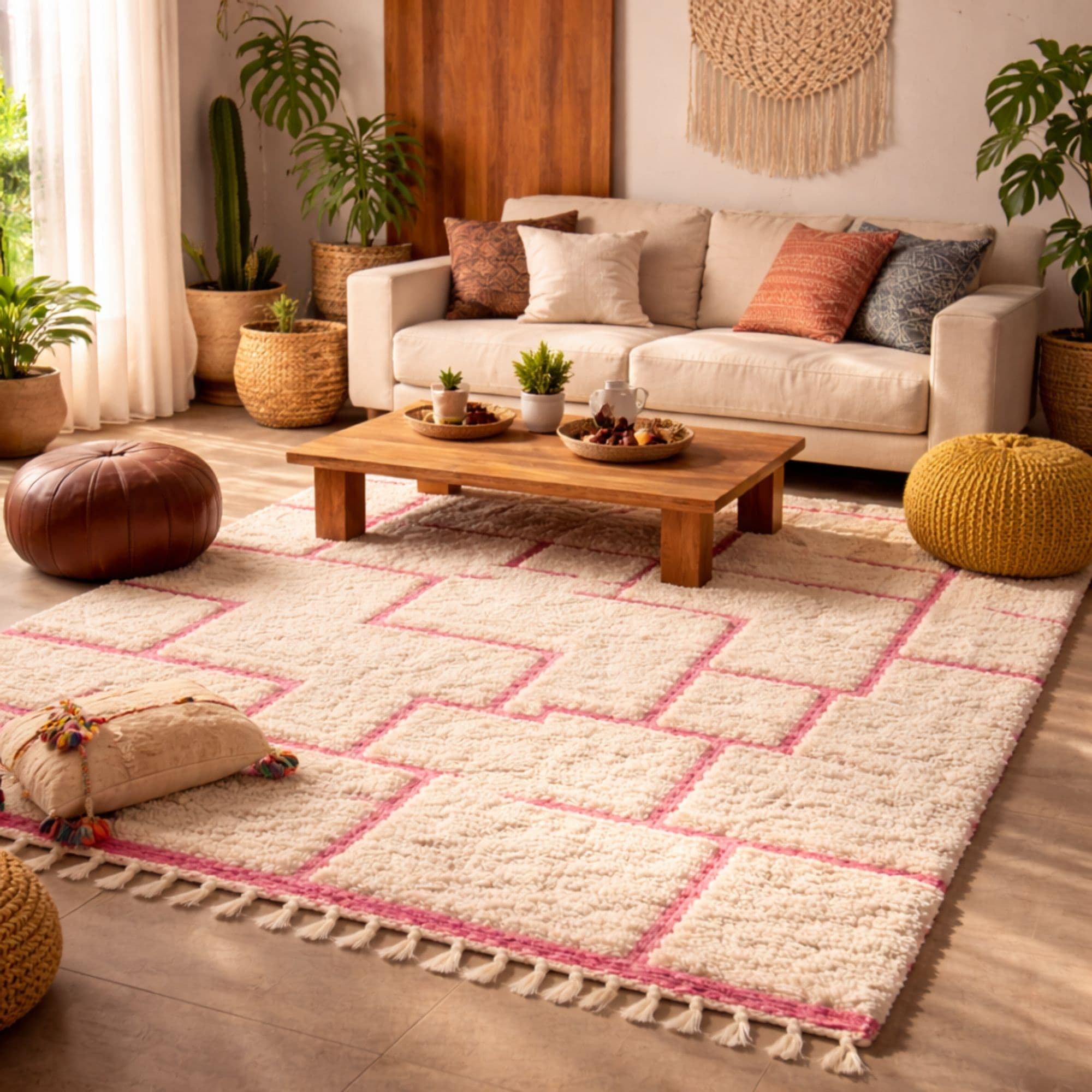
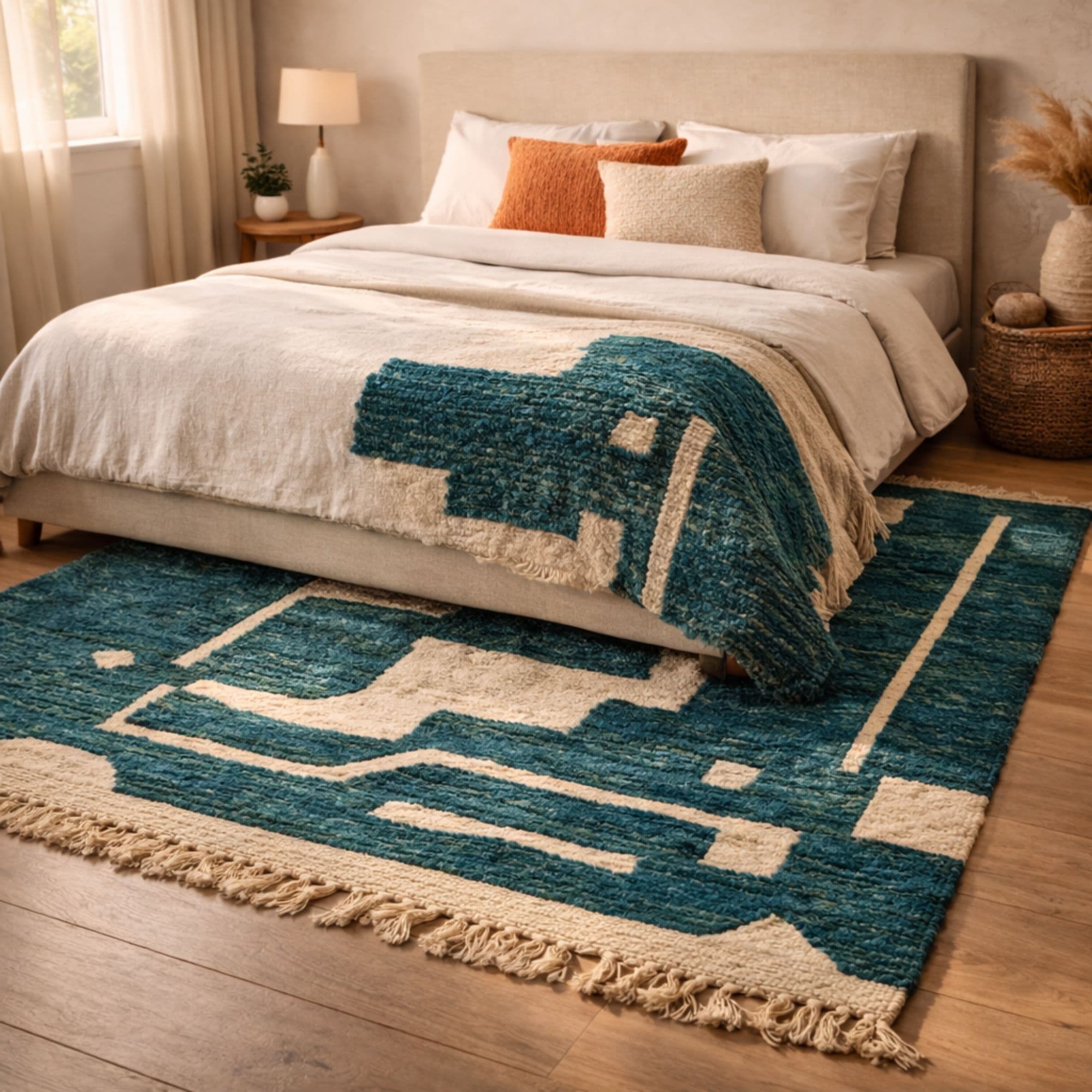
Check the palette. Authentic Beni Ourain rugs are ivory or cream with dark brown or black patterns. Full stop. If someone is selling you a “Beni Ourain” with red, blue, green, or multicolored motifs, it is not a Beni Ourain. It may be beautiful, but it is something else.
Ask about provenance. A reputable seller should be able to tell you where and how the rug was made. Vague or evasive answers about its origin are a red flag.
For a complete breakdown of authenticity indicators across all Moroccan rug types, our guide how to choose an authentic Berber rug covers every sign in detail.
Common Beni Ourain Patterns and Their Meaning
The geometric motifs on Beni Ourain rugs are not decorative in the purely aesthetic sense. They carry meaning specific to the communities that produced them, even if the precise meaning of each symbol varied among weavers and regions.
The diamond and lozenge. The diamond is the most characteristic motif of Beni Ourain rugs and one of the oldest symbols in the Berber textile tradition. It is widely associated with protection: it represents the watchful eye over the household and appears in various forms across Berber visual culture, from rugs to jewelry to tattoos. On a rug, a central diamond is often interpreted as a protective presence for the space it occupies.
Parallel diagonal lines. These motifs are associated with water: rivers, rain, and the agricultural abundance they bring. In a landscape where water is not always plentiful, wishing for it was equivalent to wishing for life, and recording that wish in an everyday object was a meaningful act.
Stepped and staircase forms. These appear frequently in compositions marking transitions: rugs woven for brides, rugs given as birth gifts, or pieces created during significant life events for the weaver. The stepped form represents a path, a journey, and by extension the passage from one stage of life to another.
Cross and X forms. These carry protective associations in most Berber traditions — functioning similarly to the diamond eye in some contexts, and representing the convergence of complementary forces in others.
It is wise to be cautious about overly precise symbolic interpretations. The meaning of patterns on Berber rugs was never systematically codified and varied by tribe, region, weaver, and era. What is certain is that these motifs did carry meaning and were not simply decorative; this intentionality contributes to the rugs’ distinctive character.
For a deeper exploration of rug symbolism, see our article on the story behind Berber rug symbols.
Why Interior Designers Love Beni Ourain Rugs
Ask an interior designer why they choose Beni Ourain rugs and you will generally get one of two answers: “they go with everything” or “it’s the only rug that doesn’t clash with the room.” Both amount to the same thing.
Scandinavian Interiors
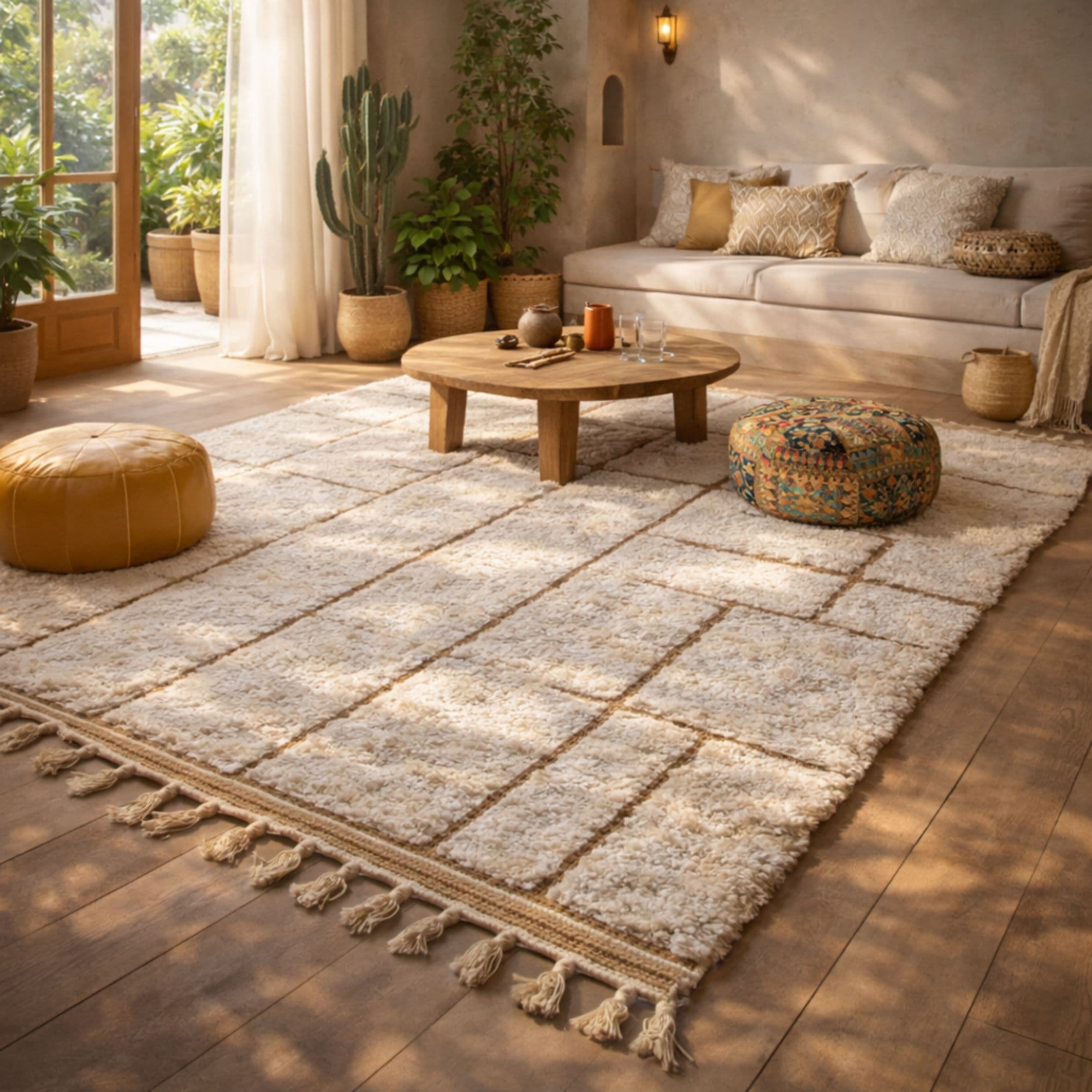
The aesthetic similarity between Scandinavian design and Beni Ourain rugs is not accidental. Both traditions value natural materials, restrained color palettes, and the authentic beauty of well-made objects. A Beni Ourain rug on a light oak floor, beneath a clean-lined sofa in natural linen, creates an ensemble so harmonious it feels effortless.
Minimalist Homes
Minimalist design is often described as “less, but better.” Beni Ourain rugs embody this philosophy perfectly: they bring warmth, texture, and visual interest without overwhelming the space. Their restrained palette allows them to integrate seamlessly into the room.
Modern Homes
In contemporary interiors with clean architectural lines, exposed concrete, or large-format tiles, Beni Ourain rugs bring the softness and warmth that hard surfaces cannot provide. They bridge the precision of modern architecture and the human need for comfort, without compromise.
Luxury Spaces
The quality of an authentic Beni Ourain rug is undeniable. The thickness of the pile, the quality of the wool, the weight, the play of light: these are the qualities that define the luxury of a functional object. In high-end interiors where material quality is paramount, a Beni Ourain rug commands attention immediately.
Contemporary Interiors
What gives Beni Ourain rugs their true versatility is their lack of fixed temporal associations. Unlike many decorative textiles that seem to belong to a specific era, Beni Ourain rugs evoke both the ancient and the modern — which is precisely the hallmark of careful, authentic craftsmanship unconcerned with trends.
For styling inspiration, see our guide to styling Berber rugs in a modern home.
Beni Ourain vs Other Moroccan Rug Styles
| Feature | Beni Ourain | Beni Mrirt | Azilal | Boujad |
|---|---|---|---|---|
| Origin | Middle Atlas (NE) | Middle Atlas (Khénifra) | High Atlas | Boujad region |
| Palette | Ivory + dark brown/black | Ivory, cream, sometimes subtle tones | Multicolored, vibrant | Multicolored, precious stone hues |
| Pile | Thick and plush | Dense, slightly shorter | Medium | Medium to flat |
| Motifs | Geometric, minimalist | Refined geometry | Abstract, expressive | Free-form, bold |
| Texture | Very soft, thick pile | Exceptionally soft and luxurious | Varied | Varied |
| Best for | Minimalist, modern, Scandinavian | Luxurious, refined bedrooms | Artistic, eclectic spaces | Bohemian, colorful interiors |
| Price range | Premium | Premium — high end | Mid-range | Mid-range |
Beni Ourain vs Beni Mrirt
These two rugs are most frequently compared, and for good reason. Both are high-pile, high-quality rugs from the Middle Atlas, woven in exceptional wool. The main differences lie in density and finish. Beni Mrirt rugs generally have a higher knot count, a slightly shorter pile, and a more refined surface — a softness some buyers compare to cashmere. Their patterns are also somewhat more complex. If Beni Ourain is defined by bold graphic minimalism, Beni Mrirt embodies understated luxury.
Beni Ourain vs Azilal
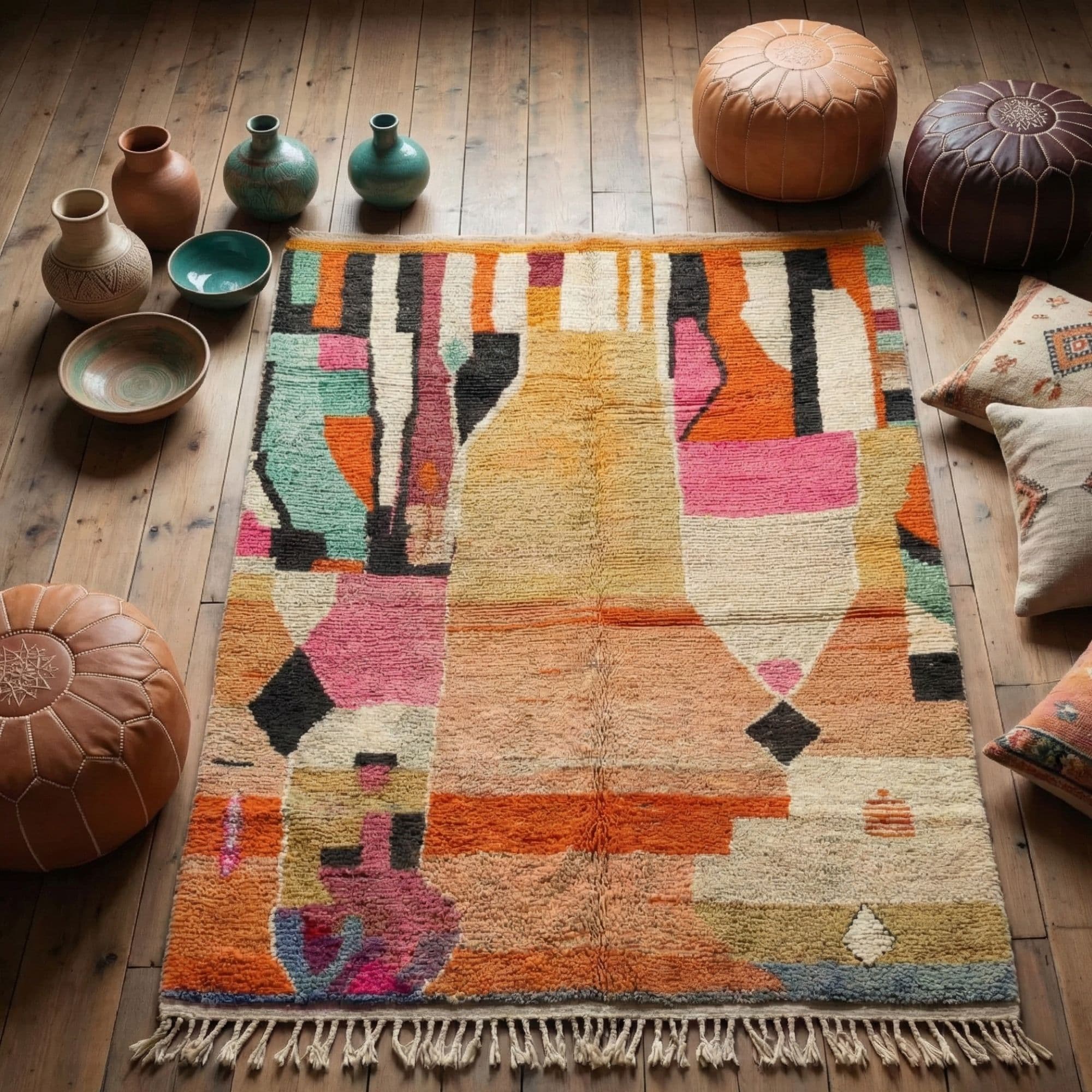
Azilal rugs from the High Atlas offer vibrant expression, the opposite of Beni Ourain restraint. Where Beni Ourain favors ivory-and-black geometric forms, Azilal rugs are defined by their vividness: reds, yellows, blues, and natural tones intermingle in compositions that feel almost painterly. Azilal weavers tend to incorporate more personal, narrative symbolism, giving each piece a unique character. If you seek warmth, color, and bold artistic personality, Azilal rugs deserve your attention; if you prefer a more architectural, neutral approach, choose Beni Ourain.
Beni Ourain vs Boujad
Boujad rugs from central Morocco have a distinctly different style: bolder, richer in color, and with a vintage charm that comes from both tradition and the fact that many of the finest examples are antique pieces. Where Beni Ourain is restrained, Boujad is exuberant. They are not intended for the same spaces, which is the simplest criterion for choosing between them.
How to Choose the Right Beni Ourain Rug
Size
The most common mistake when buying a rug is choosing one that is too small. A rug that floats in the middle of a room, with all the furniture sitting entirely beside it, creates an impression of disorganized space. As a general rule: in a living room corner, the front legs of the furniture should rest on the rug; in a bedroom, the rug should extend at least 60cm beyond the sides and foot of the bed.
For a standard living room, a 2m x 3m rug is usually a good starting point. For larger rooms, or those where the rug is meant to define the space, consider 2.5m x 3.5m or larger.
For help with sizing, see our guide to how to choose an authentic Berber rug.
Colors and Finish
Authentic Beni Ourain rugs do not come in a wide range of colors; that is part of their nature. The choice is primarily between the warmth of the ivory ground (which can vary from bright white to a more aged cream, depending on the natural wool color and its patina) and the depth of the dark motif. Warmer tones generally pair better with ivory-toned pieces; cooler, more architectural spaces can handle the contrast of a light ground with near-black patterns.
Pile Height
Beni Ourain rugs are always thick-piled, which is one of their defining characteristics. Within this category, however, there is variation, ranging from medium thickness (approximately 2.5 cm) to very thick pile (4 cm or more). Thick pile is luxurious and dramatic but requires more maintenance and can be harder to place under low furniture. Medium-thickness pile is more practical for rooms where chairs and tables sit directly on the rug.
Room Placement
Beni Ourain rugs work in almost every room of the house, but they are particularly at home in spaces where comfort and visual calm are paramount: living rooms, bedrooms, reading nooks, and home offices. They are less suited to dining rooms (food and thick-pile rugs do not mix well) and are not ideal for bathrooms.
Lifestyle Considerations
Households with young children or large dogs can absolutely accommodate a Beni Ourain rug: the wool is naturally resilient and the thick pile hides imperfections effectively. However, it requires more frequent maintenance than a low-pile rug. Shedding is normal during the first months of use (all natural wool rugs shed initially) and should diminish considerably with regular vacuuming.
Are Beni Ourain Rugs Worth the Investment?
For anyone purchasing with genuine quality in mind, the answer is yes — with the understanding that the term “investment” here has a broader meaning than mere financial return.
An authentic Beni Ourain rug, properly maintained, lasts for decades. The natural wool softens with time, the lanolin gradually infuses the pile, and the rug develops a unique patina impossible to reproduce in a new piece. Vintage Beni Ourain rugs from the 1970s and 1980s, kept in good condition and cleaned occasionally, are among the most sought-after pieces in the Moroccan textile market precisely because this aging process gives them a singular beauty.
In terms of design, Beni Ourain rugs are among the rare pieces that remain relevant despite evolving aesthetic trends. They are not subject to seasonal fashion; they integrate durably into well-considered interiors — a quality different from, and far more enduring than, trendiness.
From a sustainability perspective, a rug made from natural materials by skilled artisans and designed to last fifty years is as prudent a purchase as any other major investment. The alternative — cheap synthetic rugs to be replaced every two or three years — is worse in nearly every respect.
For a deeper exploration of value, see our article on vintage Moroccan rugs as fine art investments.
How Much Does an Authentic Beni Ourain Rug Cost?
The price of authentic, handmade Beni Ourain rugs reflects the true cost of their production: skilled labor for weeks or months, first-quality natural wool, hand-processing at every stage, and the expertise of artisans who have spent years perfecting their craft.
The main variables that influence price are:
Size. Larger rugs require more materials and more time to produce. The relationship is roughly proportional: for equivalent quality, the cost approximately doubles for twice the surface area.
Knot density. A more tightly knotted rug takes longer to produce and is generally more durable and better finished. A dense-pile rug costs more.
Wool quality. The finest Atlas wool, from flocks raised at the highest altitudes, sells for more at the source and produces a noticeably superior result in the finished rug.
Age and condition. Vintage pieces with exceptional pattern quality or documented provenance can sell for significantly higher prices than comparable contemporary works.
Custom production. A rug made to specific dimensions, pile height, or pattern specifications requires additional artisanal work and generally costs somewhat more than standard-sized rugs.
The price should not be low. An authentic, handmade Beni Ourain rug cannot be produced at the same cost as industrial alternatives. If the price seems too good to be true for a genuinely artisanal object, it almost certainly is.
How to Care for a Beni Ourain Rug
Beni Ourain rugs are more resilient than they may appear, but natural wool requires regular care.
Vacuum regularly. Maintenance should be gentle and consistent: once a week in heavily used rooms, every two weeks in less-used spaces. Use the suction-only function, without a rotating brush, which can damage and pull out fibers. Always vacuum in the direction of the pile, never against it.
Shedding is normal. It is expected that fibers will shed from the pile during the first months of use. This will diminish considerably over time and is not a sign of quality defect.
Treat stains promptly. Address stains immediately with cold water and a small amount of gentle detergent. Blot rather than rub: rubbing can spread the stain and damage the fibers. For any significant stain, it is advisable to consult a professional.
Rotate the rug. It is recommended to rotate the rug every six to twelve months in high-traffic areas. This distributes wear evenly and prevents localized compression zones.
Professional cleaning. It is advisable to have regularly used rugs professionally cleaned every two to four years. Ensure the cleaner has experience with natural wool rugs; inappropriate cleaning methods, particularly excessive heat or harsh chemicals, can damage the lanolin and permanently alter the texture.
For complete care instructions, including stain treatment and storage advice, see our comprehensive guide: how to care for a Berber rug.
Common Buyer Mistakes
Buying synthetic versions. The market is flooded with machine-made, synthetic-fiber rugs designed to mimic the Beni Ourain look. Cheaper, they deteriorate quickly: the pile flattens, colors fade, and material quality degrades. The savings are therefore temporary.
Choosing the wrong size. Selecting a rug that is too small for the room is the most frequent decorating mistake. Measure carefully. When in doubt, go one size up.
Focusing solely on price. A Beni Ourain rug is not a commodity product. Its price varies according to quality, origin, wool grade, and knot density. The cheapest option in any category is rarely the best value.
Neglecting craftsmanship. “Handmade” is not a guarantee of quality; it describes a process, not a standard. The skill and experience of the weaver, the quality of the wool, and the care put into finishing all determine whether a handmade rug is excellent or merely made with average materials. Research the artisan, not just the method.
Buying from unknown sources. Provenance matters. Purchasing from a seller who maintains genuine relationships with Moroccan artisan communities is the best way to ensure both authenticity and ethical production. Anonymous online listings with no origin information are a constant red flag.
For a detailed breakdown of handmade vs machine-made rug differences, see our guide: handmade vs machine-made rugs.
Buyer’s Checklist: What to Confirm Before Purchasing
Before buying a Beni Ourain rug, verify the following:
- The pile is natural wool, warm to the touch, with no plasticky or synthetic feel.
- The back shows a hand-knotted structure with visible, slightly irregular knots.
- The palette is ivory/cream with dark brown or black motifs only.
- Natural variations in symmetry and pile height are present.
- The seller can confirm the rug’s origin and weaving method.
- The price reflects real labor and material costs.
- The dimensions have been measured against the actual room, not estimated.
- The seller has a clear after-sales service and return policy.
Frequently Asked Questions
What is a Beni Ourain rug?
A Beni Ourain rug is a hand-knotted pile rug originating from the Beni Ourain tribal region in Morocco’s Middle Atlas Mountains. Authentic pieces are woven in natural ivory or cream wool with dark brown or black geometric motifs, using traditional hand-knotted techniques passed down through generations by Berber artisans.
Are Beni Ourain rugs handmade?
Every authentic Beni Ourain rug is entirely handmade: knotted by hand on a traditional loom, from naturally processed wool. Authentic production involves no mechanized steps. Industrial copies exist, but they are distinguishable by their perfectly uniform pile, tufted backs, and synthetic materials.
Why are Beni Ourain rugs expensive?
Their price reflects their production: weeks or months of hand-knotting by expert artisans, first-quality natural wool from Atlas Mountain sheep, and the expertise of craftspeople who have dedicated years to mastering their art. An authentic rug justifies its price through the true cost of its production, built to last for decades. Cheap imitations are cheap because they do not deliver on their promises.
How long do Beni Ourain rugs last?
A well-made Beni Ourain rug, properly maintained, will last fifty years or more. Mid-twentieth-century vintage pieces are still in use and often more beautiful than when new, having acquired a softness and patina that only time and use can confer. Natural wool is inherently durable, and the hand-knotted construction allows for occasional repairs if needed.
Can Beni Ourain rugs be used in high-traffic areas?
Yes, with some caveats. Natural wool is resilient and the thick pile of a Beni Ourain rug handles moderate foot traffic well. In very high-traffic zones like hallways, the pile may compress over time. Regular rotation and occasional professional cleaning help preserve the pile in heavily used areas.
How can I tell if a Beni Ourain rug is authentic?
Check the wool (warm, slightly waxy, not synthetic), examine the back (individually visible knots, same pattern as the front), confirm the color palette (ivory and dark brown/black only, no other colors), and look for natural variations in symmetry and pile height. A reputable seller should be able to confirm the origin and weaving method without hesitation.
Are Beni Ourain rugs still in style?
The question slightly misses the point. Beni Ourain rugs have been prized in design interiors for over sixty years and continue to appear in an exceptionally wide range of contemporary styles: minimalist, Scandinavian, luxury, and organic. Objects of such quality do not follow trends; they transcend them.
Which rooms are best suited for Beni Ourain rugs?
The living room and bedroom are the most common and successful placements. They also work well in home offices, reading rooms, and entryways. The dining room is trickier (food and thick-pile rugs require extra caution), and the bathroom is not recommended. The most important factor is sizing the rug to the room: a Beni Ourain rug that is too small loses its impact.
Conclusion
Beni Ourain rugs represent one of the most beautiful convergences of cultural heritage, material quality, and timeless aesthetic value in the world of artisanal textiles. Designed for the cold floors of mountain villages before they were destined for decoration magazines, their original purpose — warmth, comfort, beauty, protection — remains palpable in every piece.
Understanding what makes a Beni Ourain rug authentic means understanding the wool, the craftsmanship, the tradition, and the time required to produce one. It means knowing that slight irregularities are not defects, that the two-tone palette is a feature not a limitation, and that the price of a genuine rug reflects an irreplaceable artisanal skill — impossible to replicate identically or to industrialize.
At Nomadinas, every Beni Ourain rug we offer comes directly from Moroccan Berber artisan communities, with complete transparency about its origin and how it was made. We invite you to explore our collection and to ask us anything. We are here to help you find not just a rug, but a piece that will endure.
-(1).jpg&w=2560&q=75)