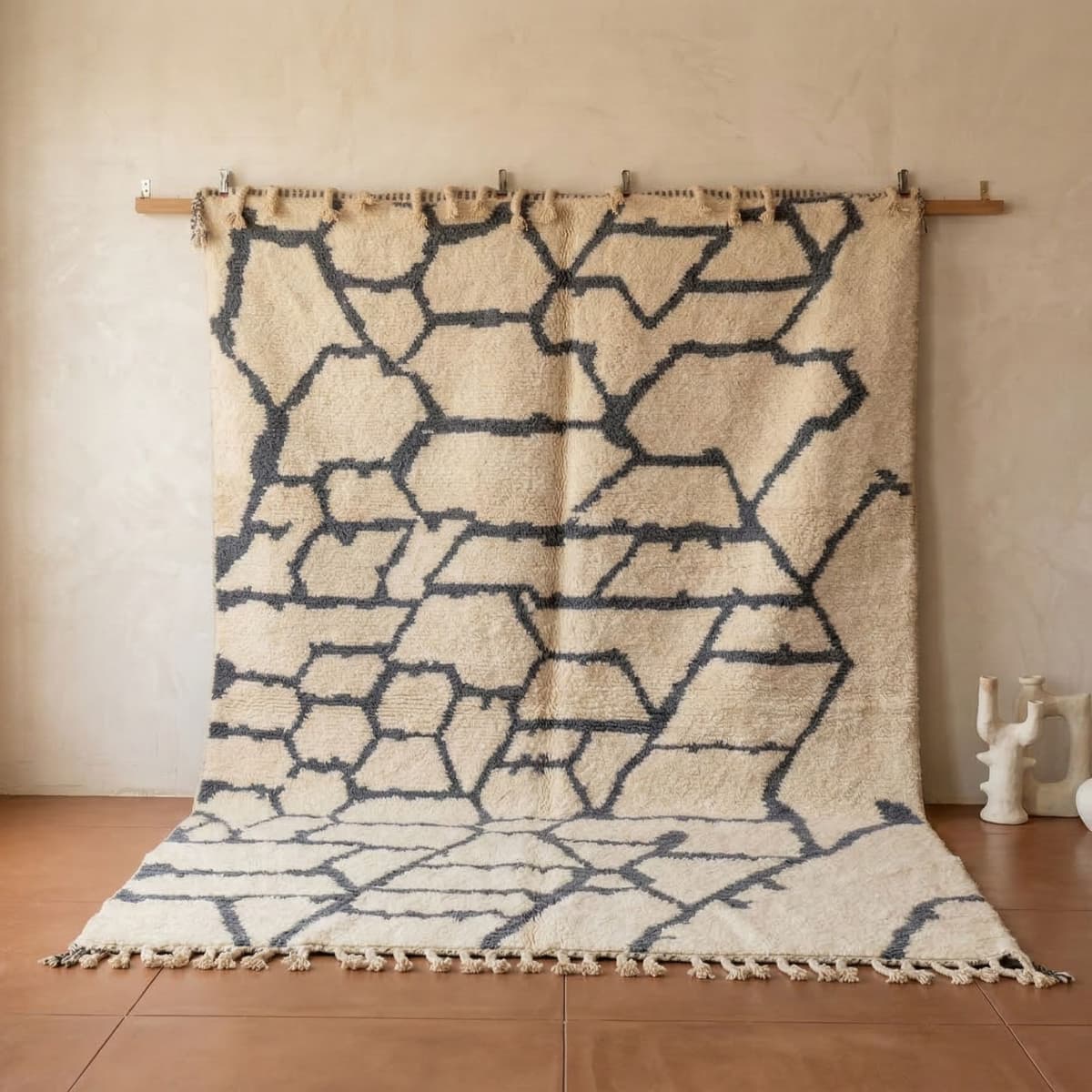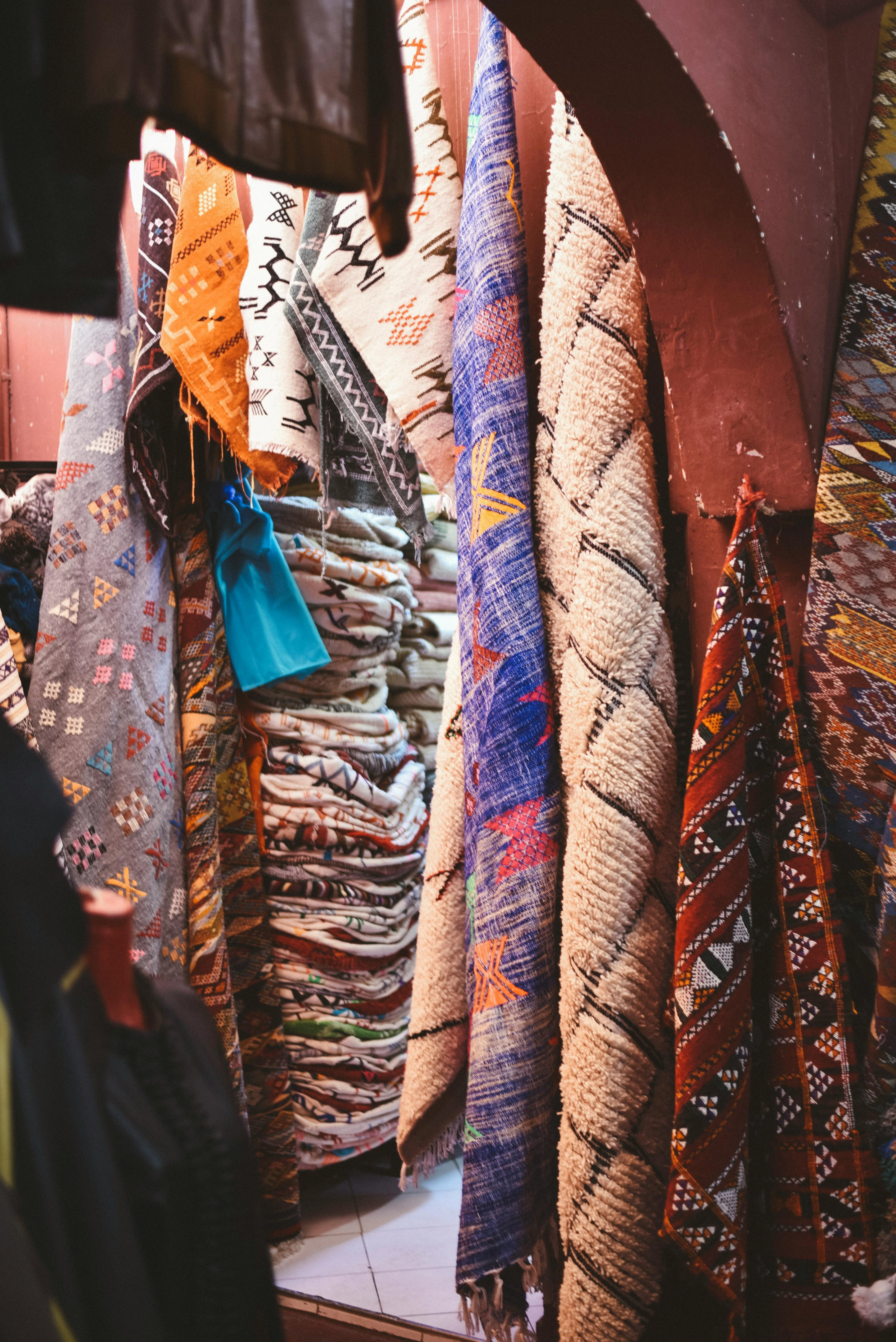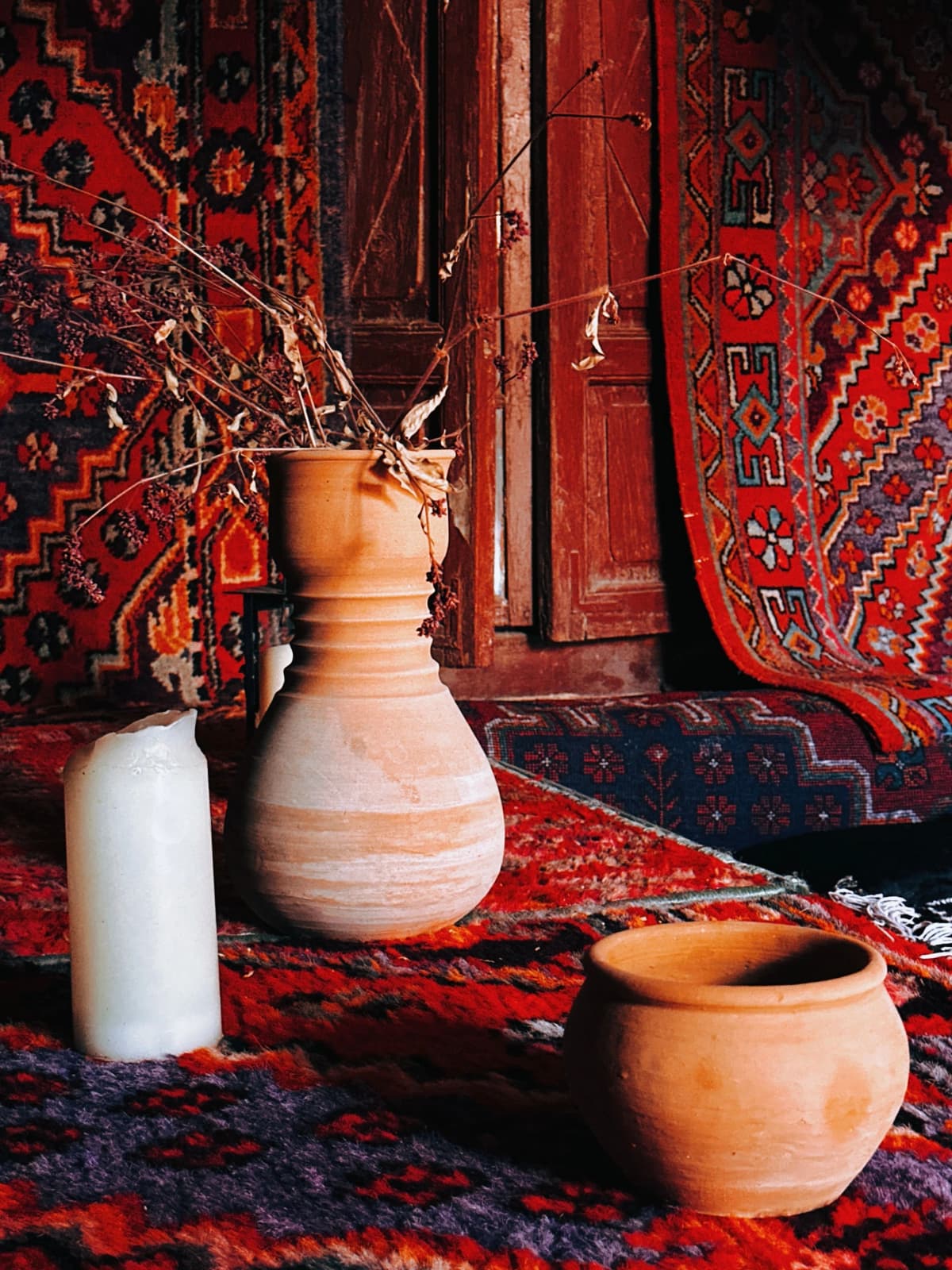
In the global lexicon of luxury interior design, the Moroccan rug is almost universally synonymous with light. The mind immediately conjures the iconic "White Giants" of the Beni Ouarain—expansive, plush seas of pristine ivory wool, delicately traced with minimalist black geometric lines. For decades, these bright, snow-colored textiles have illuminated the world's most coveted living spaces.
But for the true connoisseur, the seasoned collector, and the avant-garde designer, there is another narrative hidden within the Atlas Mountains. It is a story not of light, but of shadow.
Beyond the famous white fleeces lies an incredibly scarce, highly secretive world of Moroccan weaving: the black-ground rug. At Nomadinas, we believe that true luxury is defined by rarity and historical gravity. To seek out, authenticate, and unroll a dark-ground Amazigh (Berber) carpet is to possess one of the most elusive and dramatically beautiful artifacts of North African tribal art.
It is time to step into the shadows and explore the midnight weaves of Morocco.
The Mystery of the Black Fleece
Why are dark-ground Moroccan rugs so incredibly difficult to find? The answer lies in the harsh realities of agricultural history and the rigorous demands of nomadic survival.
For centuries, the Amazigh pastoralists of the Middle Atlas Mountains bred their flocks of sheep specifically to yield pristine, un-dyed white wool. White wool was not only highly prized for its luminous aesthetic qualities but was also essential for producing textiles that could be easily dyed with natural botanicals like madder root and wild saffron. Dark wool, conversely, could not be over-dyed with these vibrant hues. Consequently, black sheep were a minority in the flocks, yielding only enough dark fleece to weave the thin, contrasting lines and geometric borders of traditional white carpets.
Because of this agricultural reality, entirely black-ground rugs are very rare in the Middle Atlas region. They represent a profound deviation from the norm—a deliberate, painstaking effort by a weaver who gathered, spun, and hoarded the scarce dark wool of her flock to create something entirely unique.
However, historical evidence suggests that these moody, dark textiles may not have always been so elusive. The existence of old black-brown shawls from the Beni bou Zart region, a type which for some fifty years has been woven with a white ground, as well as the use of un-dyed black yarn for the weft of old Marmoucha rugs, suggests that black-ground rugs were more common at one time than they later became. Today, finding an intact, vintage black-ground rug is akin to discovering a hidden vein of onyx in a diamond mine.
The Tribes of the Shadows: Marmoucha and Zemmour
When collectors do uncover these rare midnight weaves, their provenance usually points to a very specific, isolated cluster of tribes.
Apart from a remarkable Marmoucha piece housed in the Musée Batha in Fez, we know of only a few Zemmour and Ait Serrouchène examples of black-ground rugs. The Marmoucha tribe, neighbors to the Beni Ouarain, are renowned for their powerful, monumental design language. When they utilized a dark canvas, their carpets took on a fiercely architectural presence. The heavy, un-dyed black and brown wool served as an impenetrable night sky, against which they would occasionally knot sudden, violent bursts of bright color or stark white tribal symbols.
The Zemmour, hailing from the more temperate plains and foothills, also occasionally produced these dark marvels. A vintage black-ground Zemmour is an exercise in graphic intensity, possessing a gravitational pull that immediately anchors any room it inhabits. The rarity of these pieces makes them the ultimate prize for collectors who wish to push past the ubiquitous white rugs and delve into the deeper, more complex history of Moroccan craftsmanship.
The Ait Youb: The Bridge Between Light and Dark
To fully understand the nuances of these rare weaves, one must look to the tribes that sit geographically and aesthetically between the major confederations. The Ait Youb tribe, for instance, is settled between the tribal regions of the Beni Ouarain and the Marmoucha.
The Ait Youb rugs have been little discussed to date, yet they possess a structural handle that feels distinctly like those of the Marmoucha, owing to a somewhat lower number of wefts. While the Ait Youb predominantly wove white-ground rugs, their design language is fierce and captivating. They almost always utilized a signature line of sawtooth motifs with "eyelashes" on both sides, creating a jagged, electric energy across the wool.
When the Ait Youb, or their neighbors, ventured into darker wools, the monumental impact of their dense designs and the accompanying side elements became incredibly pronounced, radiating a primitive, commanding aura that feels staggeringly contemporary today.
The Beni Jelidassen: Goat Hair and Polychrome Explosions
While the pursuit of the black-ground rug leads us into the shadows, we must also explore the dark, incredibly rare textiles woven by the Beni Jelidassen. As the southeasternmost tribe of the Beni Ouarain, the Beni Jelidassen practice a semi-nomadic lifestyle that has remained remarkably unchanged for centuries.
Their weaving tradition is an absolute anomaly in the Middle Atlas. While they produced carpets related to the Beni Ouarain, they also crafted an incredibly rare series of pile-woven cushions—known as loussada when made up as cushions, and frach when opened out for use as a rug.
A particular feature of the Beni Jelidassen region is the use of goat hair, or a mixture of goat hair and wool, for the warps. The introduction of goat hair provides the textile with an incredibly durable, rigid, and deeply textured foundation. Against this dark, coarse background, the women of the Beni Jelidassen unleashed an astonishing color palette. It is very surprising to see such a variety of colors used by a Beni Ouarain tribe; apart from the usual white and black, we find blue, dark red, green, orange and yellow as colors of completely equal weight.
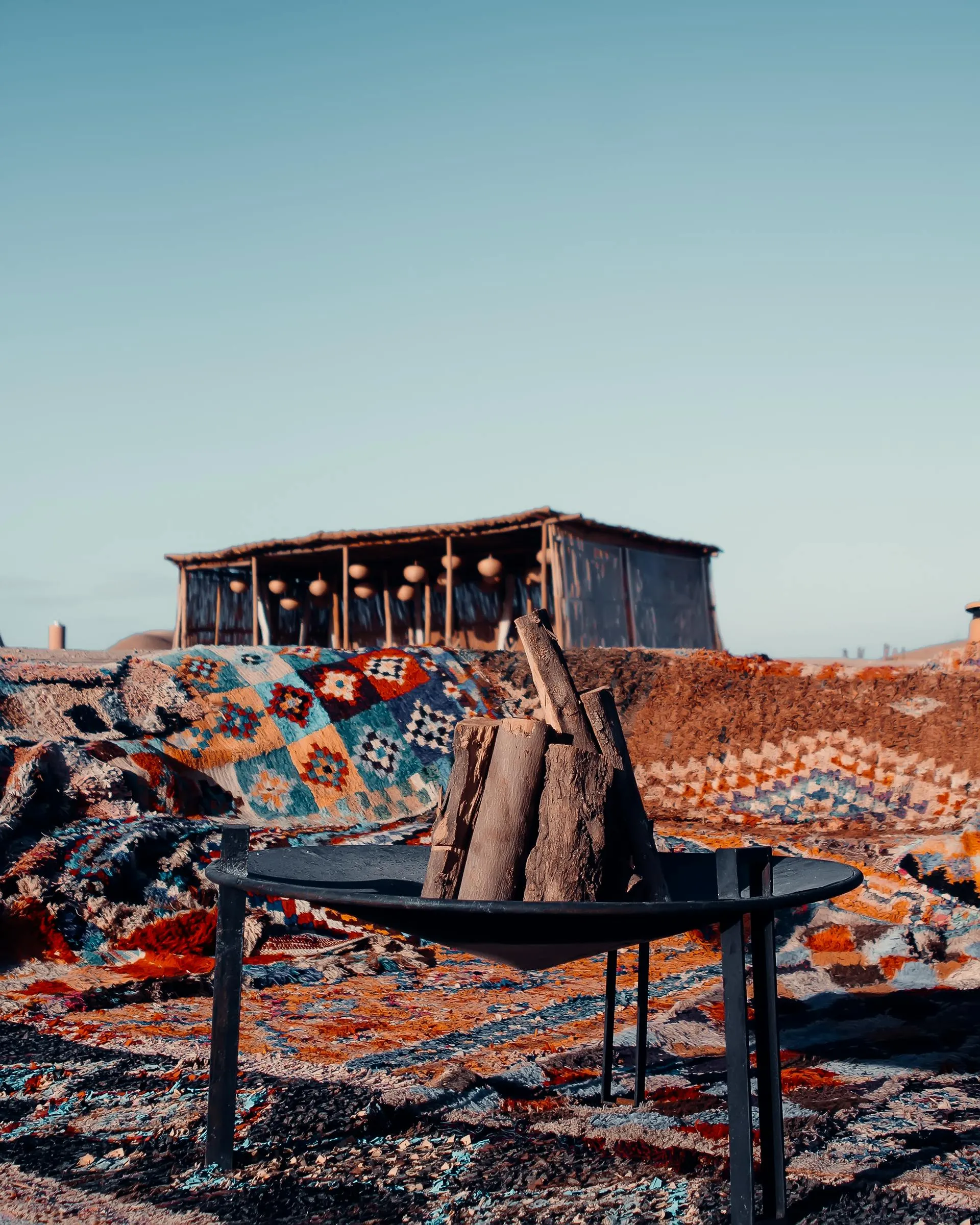
These opened-out frach rugs look like brilliant, polychrome jewels scattered across the dark, rocky earth of the Jebel bou Iblane mountains. They are a testament to the fact that within the dark weaves of the Atlas, there exists a profound and unexpected vibrancy.
Styling the Midnight Weave in the Modern Home
Integrating a rare black-ground or heavily dark-toned Moroccan rug into a luxury interior is an exercise in mastering visual drama.
While the classic white Beni Ouarain lightens a room and provides a soft, airy foundation, the black-ground rug does the exact opposite: it grounds the space with undeniable, heavy architectural weight. These rugs are not meant to blend in; they are meant to dominate.
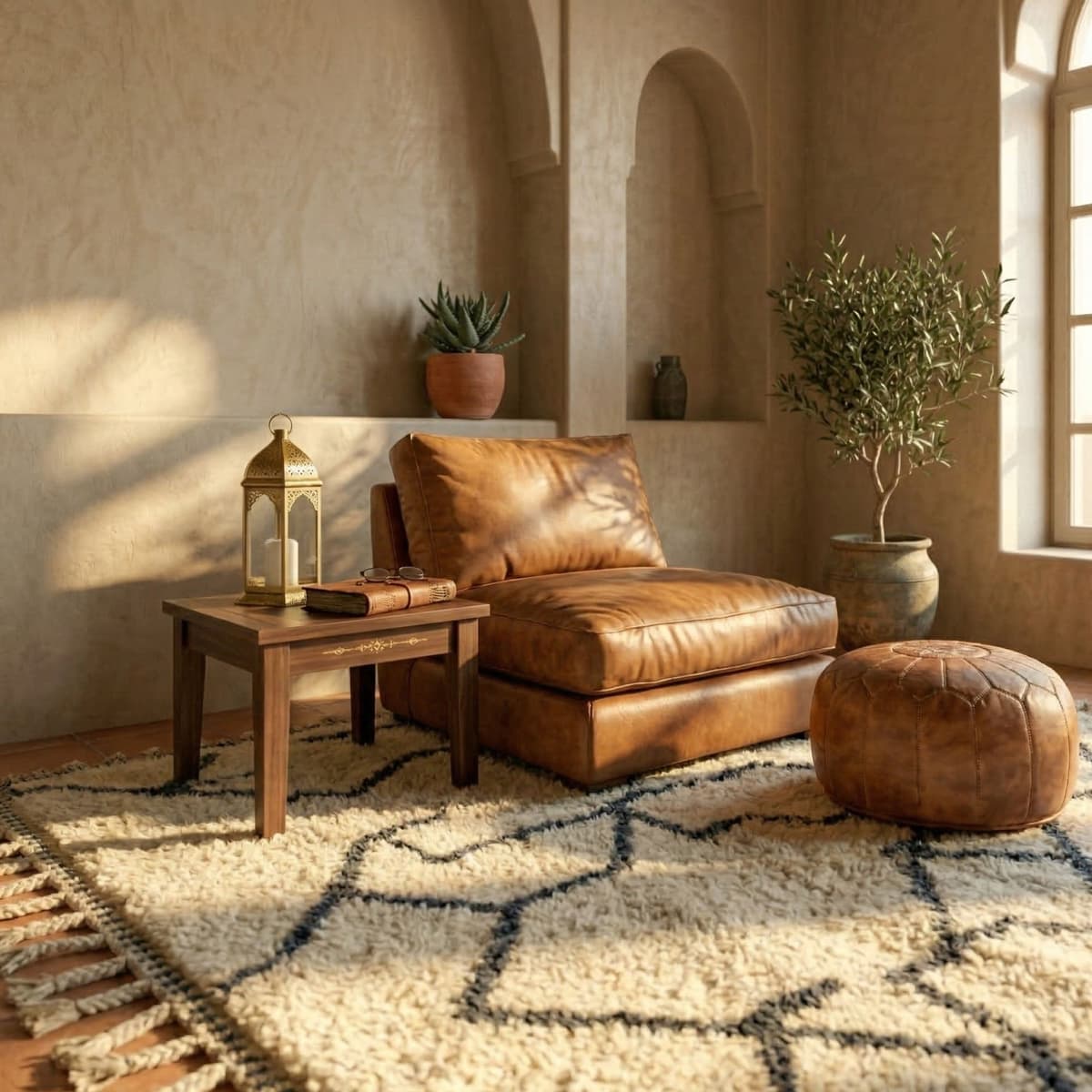
In a stark, light-filled minimalist space with white walls and pale oak floors, a black-ground Marmoucha or Zemmour rug creates a breathtaking, high-contrast anchor. It draws the eye downward, making the ceilings feel higher and the surrounding furniture appear more sculptural. Conversely, in a moody, intimately lit room featuring dark plaster, rich walnut woods, and deep leather upholstery, the midnight weave enhances the enveloping, sensory nature of the sanctuary.
Because of their rarity, these pieces should be treated as fine art. They are exceptional candidates for professional mounting, hung as massive, textured abstract canvases on a gallery wall.
The Nomadinas Pursuit
The pursuit of the perfect vintage Moroccan rug is a journey into the soul of the Amazigh people. But the pursuit of the black-ground rug is a journey into their most guarded secrets.
At Nomadinas, we are relentless in our search for these elusive masterpieces. We traverse the remote valleys and forge deep relationships with rural families to rescue and preserve these incredibly rare textiles. When you acquire a dark-ground rug or a goat-hair frach from our collection, you are not merely purchasing a piece of decor. You are securing an artifact of immense scarcity. You are bringing the dramatic, uncharted shadows of the Atlas Mountains directly into your home, proving that true luxury is often found in the dark.