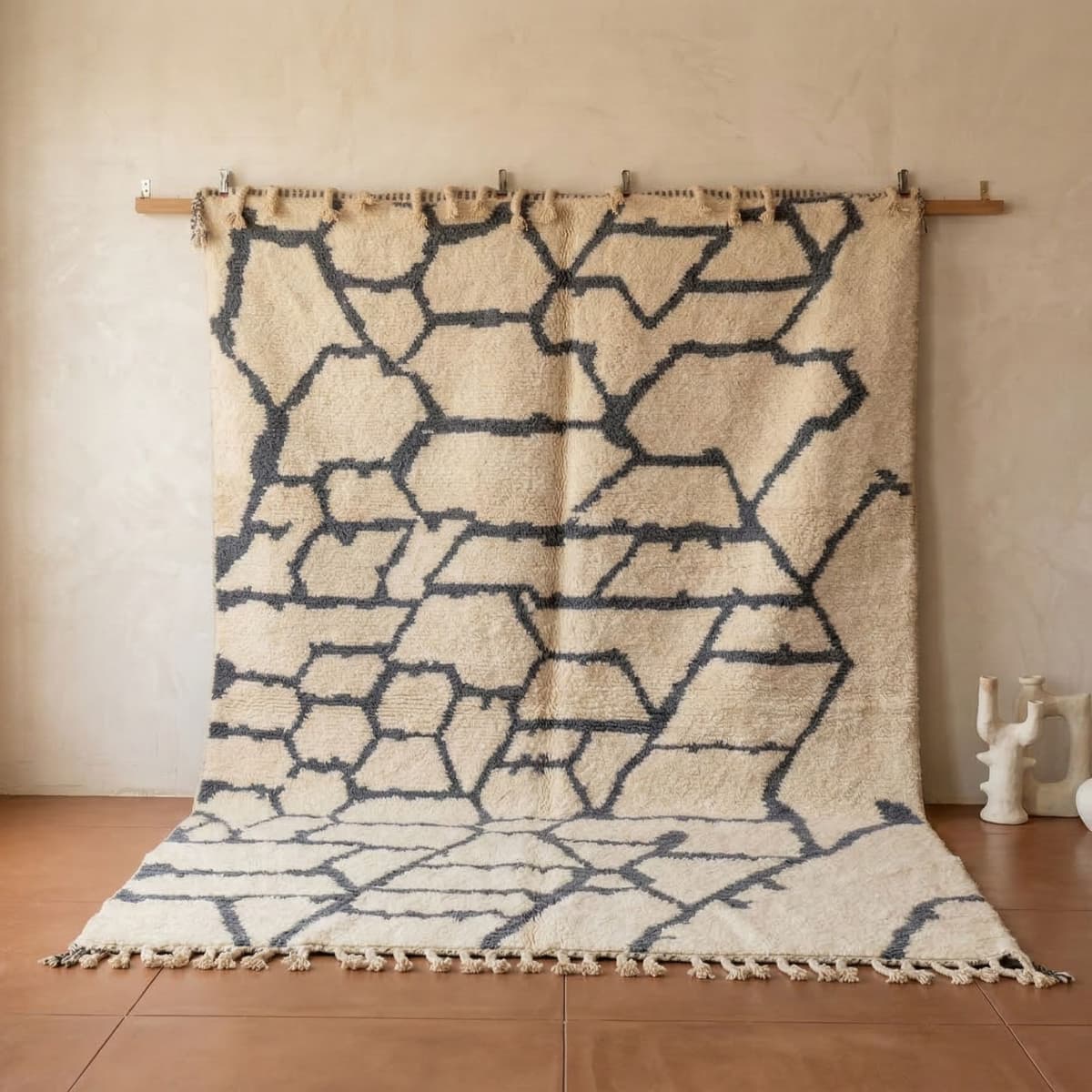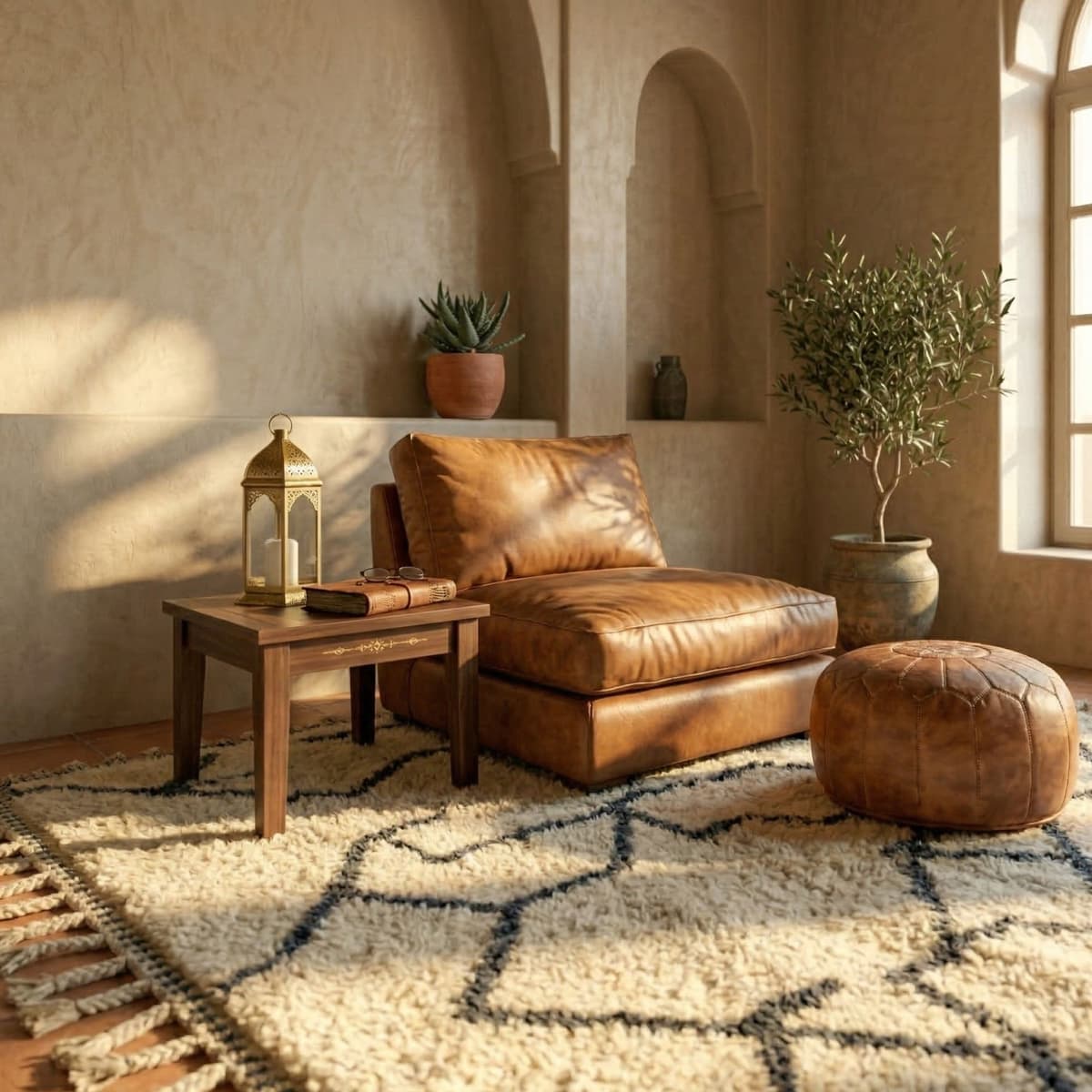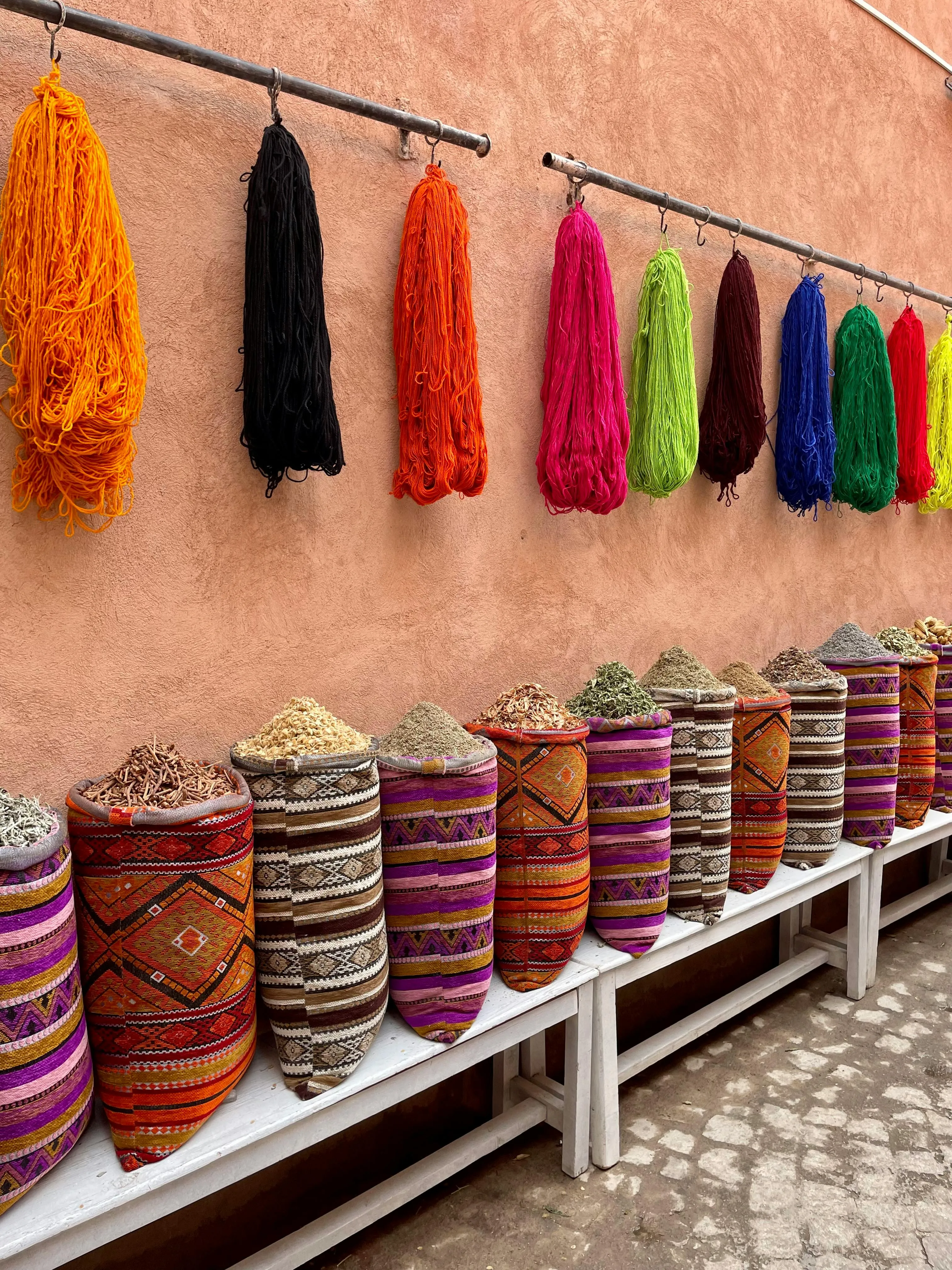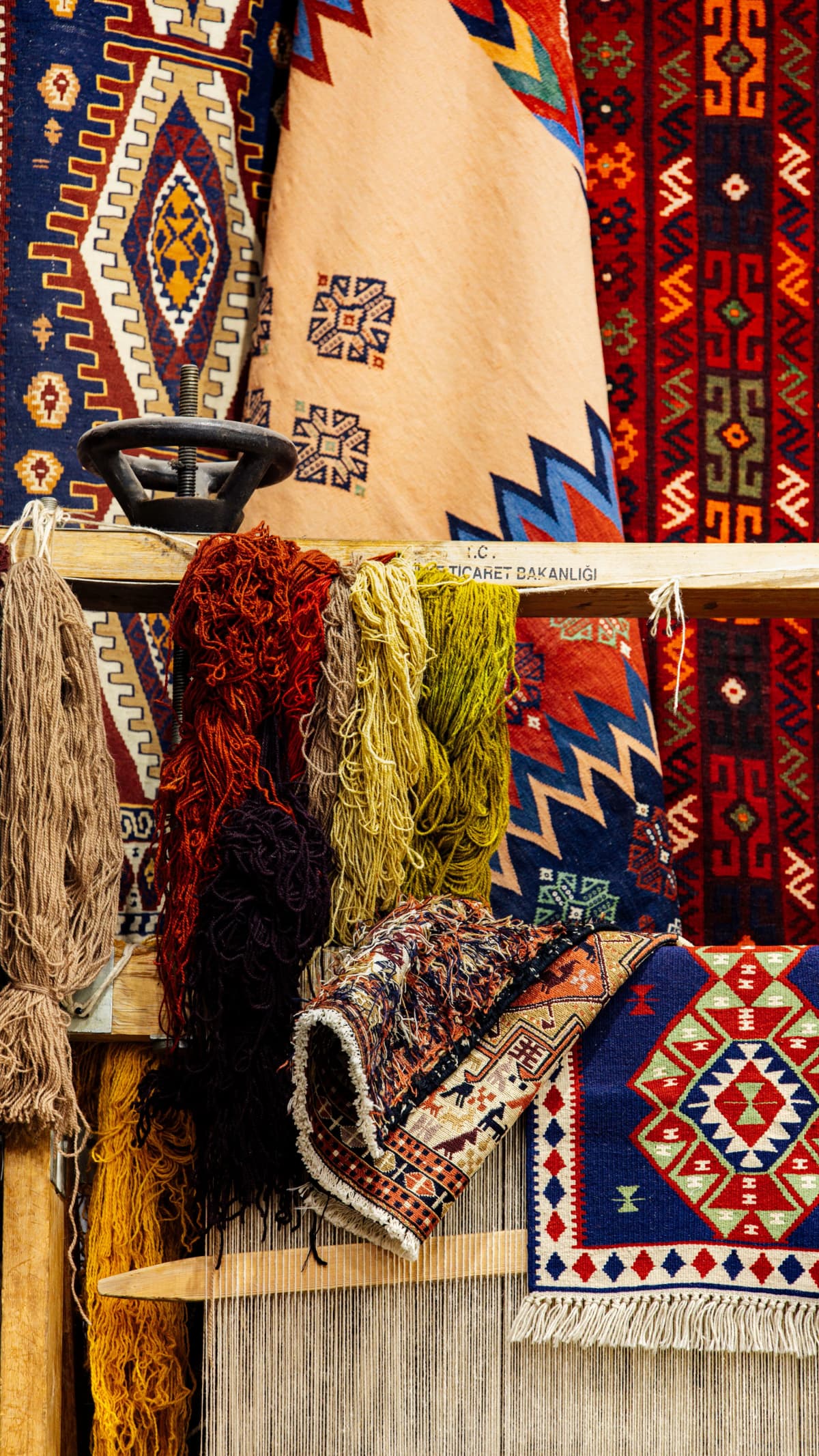
In the rarefied world of high-end interior architecture and fine art curation, there is a legendary, unspoken pairing. It is a visual dialogue that bridges continents, centuries, and vastly different ways of life. We are speaking, of course, of the striking aesthetic parallels between the artwork of classic 20th-century modernism and the visual world of Moroccan tribal carpets.
At Nomadinas, we often discuss the visual tension created when a vintage Beni Ouarain or a vibrant Boujad rug is dropped into a sleek, contemporary space. But this phenomenon is not a recent design trend. The relationship between Western abstract art and the colorfully graphic, deeply symbolic Berber tribal carpets of Morocco has been a subject of intense, sometimes obsessive, debate among collectors and art historians for decades.
How did rural Amazigh women, weaving for survival in the remote altitudes of the Atlas Mountains, arrive at the exact same visual conclusions as the pioneers of the European avant-garde? To answer this, we must look to the architectural minds that dedicated their lives to uncovering the "missing link" between the loom and the canvas.
The Search for the Missing Link
At first glance, the relationship between modern art and Moroccan textiles appears incredibly obvious. Throughout the 20th century, a steady stream of visionary visual artists, architects, and writers traveled to the Maghreb in search of inspiration. Masters of modernism like Paul Klee, August Macke, and Le Corbusier famously journeyed to North Africa to study the light, the architecture, and the indigenous arts. Many other legendary creatives, including Brice Marden, Jack Kerouac, and Jacques Majorelle, stayed for extended periods, deeply embedding themselves in the Moroccan landscape.
It is easy to assume that these Western artists simply observed the striking geometry of Amazigh rugs and translated those forms onto their canvases. However, the reality of this artistic exchange is far more complex and profoundly more beautiful.
No one understood this better than the German architect and renowned collector, Professor Jürgen Adam. Rather than accepting the superficial attempts to establish a direct, linear link between Western painting and Moroccan weaving, Adam spent forty years engrossed in painstaking, obsessive work with the textiles themselves. He wanted to know if mutual influences could truly be proven, or if something far more mystical was at play.
Point, Line, and Plane: The Architecture of the Rug
Jürgen Adam began collecting Moroccan rugs in the 1960s, a golden era that granted him access to extraordinary, historic pieces that have long since disappeared from the commercial market. His collection grew to include breathtakingly wild pile carpets from the Rehamna and Boujad regions, alongside a vast number of exceptionally complex, monochrome pieces from the Middle Atlas.
As an architect, Adam approached his collection not merely as a buyer of beautiful objects, but as a scientist of form. When evaluating these tribal pieces, he focused relentlessly on the investigation of design principles. Factors that typically obsessed traditional rug dealers—such as the exact age or the strict regional origin of a piece—were of secondary importance to him when judging the fundamental, formal issues of the art.
Fascinatingly, Adam began classifying his massive collection of Moroccan tribal rugs based on the foundational texts of modern art theory—specifically, Wassily Kandinsky's seminal 1926 manifesto, Point and Line to Plane. He looked at the woven knots, the asymmetrical borders, and the floating geometric fields of the Berber rugs, and realized they were speaking the exact same structural language as the Bauhaus masters.
His lifetime of research culminated in the legendary 2013/14 exhibition at the Pinakothek der Moderne in Munich, aptly titled 'Moroccan Carpets and Modern Art'. The exhibition, and its wildly influential catalogue, shattered the boundaries between "tribal craft" and "fine art," cementing the Moroccan rug as a blue-chip collectible.
Beyond the Surface: Astonishingly Similar Solutions
What Jürgen Adam ultimately discovered after forty years of searching for a direct, formal relationship is perhaps the most poetic truth in the history of design.
As he delved deeper into the material, it became abundantly clear that you cannot discern a direct, linear relationship just by looking at the visual surface. The European painters did not simply "copy" the weavers, nor did the weavers mimic the painters. Instead, Adam's search for a formal link blossomed into a sense of open, profound amazement.
He realized that artistic processes stemming from entirely different individual viewpoints, utilizing completely different media, methods, and speeds of creation, can miraculously lead to astonishingly similar solutions.
An Amazigh woman in the Atlas Mountains, weaving a heavy wool carpet to protect her family from the freezing winter snows, was driven by a need for survival, a connection to her ancestral symbols, and the rhythmic, slow meditation of the vertical loom. A European modernist, standing before a canvas in a 1930s Parisian studio, was driven by a philosophical desire to strip away Victorian excess and find the pure, emotional core of color and geometry.
Though separated by thousands of miles, vastly different cultures, and entirely different motivations, both artists arrived at the exact same aesthetic truth: that beauty is found in abstract reduction, asymmetrical balance, and the raw power of unadulterated color.
The Lost Masterpieces of Rehamna and Boujad
To truly understand this modernist connection, one must look beyond the famous black-and-white Beni Ouarain rugs to the more expressionistic weavings of the Moroccan plains.
The pieces that most deeply capture the chaotic, vibrant energy of modern abstract painting often hail from the Arabic-speaking areas west of the Boujad region, crafted by the Sraghna or Rehamna tribes. The vintage rugs from these regions—many of which have completely vanished from the open market—are breathtaking exercises in abstract expressionism.
They feature highly expressive, unpredictable patterns. A Rehamna rug might start with a rigid, geometric border, only to have that border dissolve halfway down the textile into a swirling, spontaneous field of brilliant red and deep indigo. The weavers of these regions were entirely uninhibited by the need for perfect symmetry, allowing their intuition to guide the wool. The resulting textiles look as though they could have been painted by Mark Rothko or Joan Miró.
Curating the Modernist Soul at Nomadinas
The legacy of collectors like Jürgen Adam fundamentally changes how we must view Moroccan textiles. They are not merely floor coverings to be walked upon; they are the physical manifestations of a universal, artistic truth. They are proof that genius is not restricted to the academies of the West, but thrives equally in the earthen homes of the Atlas Mountains.
At Nomadinas, we curate our collection of Moroccan rugs with the exact same reverence and architectural eye. When we source a heavily textured, vintage Boujad or a starkly minimal Middle Atlas piece, we are looking for that specific, electric tension—the "primitive modernism" that captivated the 20th century's greatest artistic minds.
Whether you are anchoring a stark, concrete-clad architectural home or layering warmth into a mid-century space, an authentic Moroccan rug offers a profound dialogue between the ancient and the avant-garde. It invites the astonishingly similar solutions of the weaver and the painter directly into your sanctuary.