> Did you know? At Nomadinas, every rug is signed by the woman who made it — a deliberate rejection of the "anonymous artisan" label that has long plagued tribal art. Studies show that female artisans who receive named attribution earn 25-40% more for their work than those who remain anonymous. Of the 30+ weaver families we partner with across the Middle Atlas, all are named and credited publicly, with their personal stories and techniques documented alongside each rug.
Walk into almost any major Western ethnographic or fine art museum, locate the wing dedicated to African or tribal textiles, and read the placards mounted neatly beside the masterpieces. More often than not, you will find a single, pervasive word acting as the artist’s signature: Anonymous.
For generations, the global art market has categorized the staggering creative output of rural, indigenous women under the umbrella of “anonymous tribal craft.” It is a romanticized, deeply flawed concept that suggests these intricate Moroccan rugs merely sprang from the earth as a collective, nameless ethnic reflex.
At Nomadinas, we fundamentally reject this narrative. Anonymity is not a reality of the loom; it is a mythology formulated in the 19th century by those who egotistically imagined themselves the guardians of fine art. It is time to lift the veil of anonymity and celebrate the Amazigh (Berber) women for what they truly are: highly individualized, visionary masters of design.
The Boomerang Effect of the Western Gaze
The celebrated art critic and curator Simon Njami famously argued that anonymity is merely a projection—a phenomenon waiting to be activated and charged with meaning by the outsider's gaze. When we label a master weaver as anonymous, we are stripping away her agency. We are suggesting that because her work does not conform to the precise canons of Western artistic classification, her name does not matter.
As Njami points out, a soldier buried beneath the Arc de Triomphe is not “anonymous”—he is an “unknown,” because we view him as one of us, a hero whose specific identity was tragically lost. But when dealing with the art of the African continent, the establishment has historically used “anonymous” as a box to arrange foreign creativity into a category that requires no further intellectual engagement.
Of course, an anonymous person has a name. She has a life, a family, and she makes brilliant, deliberate choices every time she sits before her warp threads.
The Aït Khebbach Designers: A Case Study in Identity
Nowhere is the dismantling of this myth more vibrant than in the contemporary weaving of the Aït Khebbach tribe in eastern Morocco.
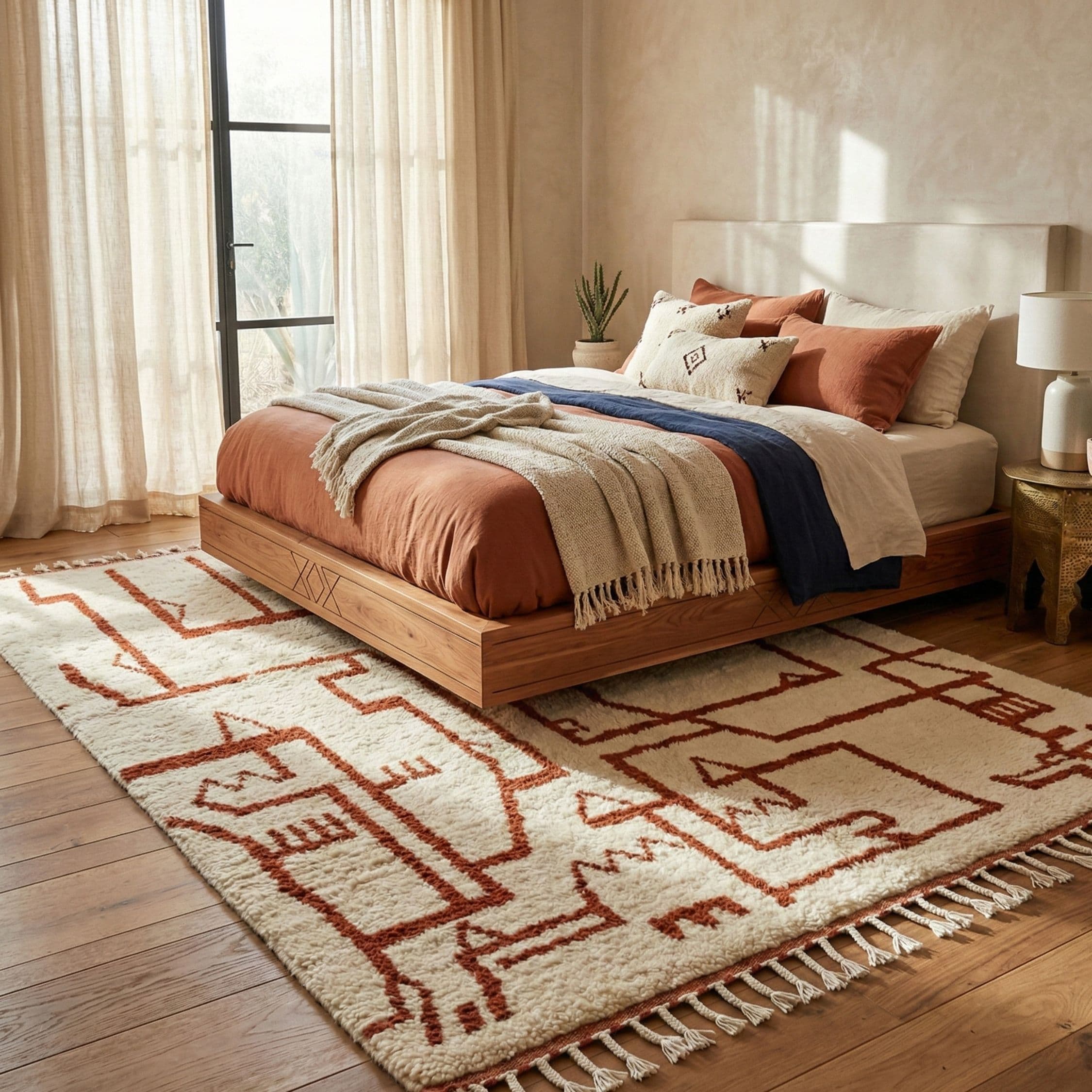
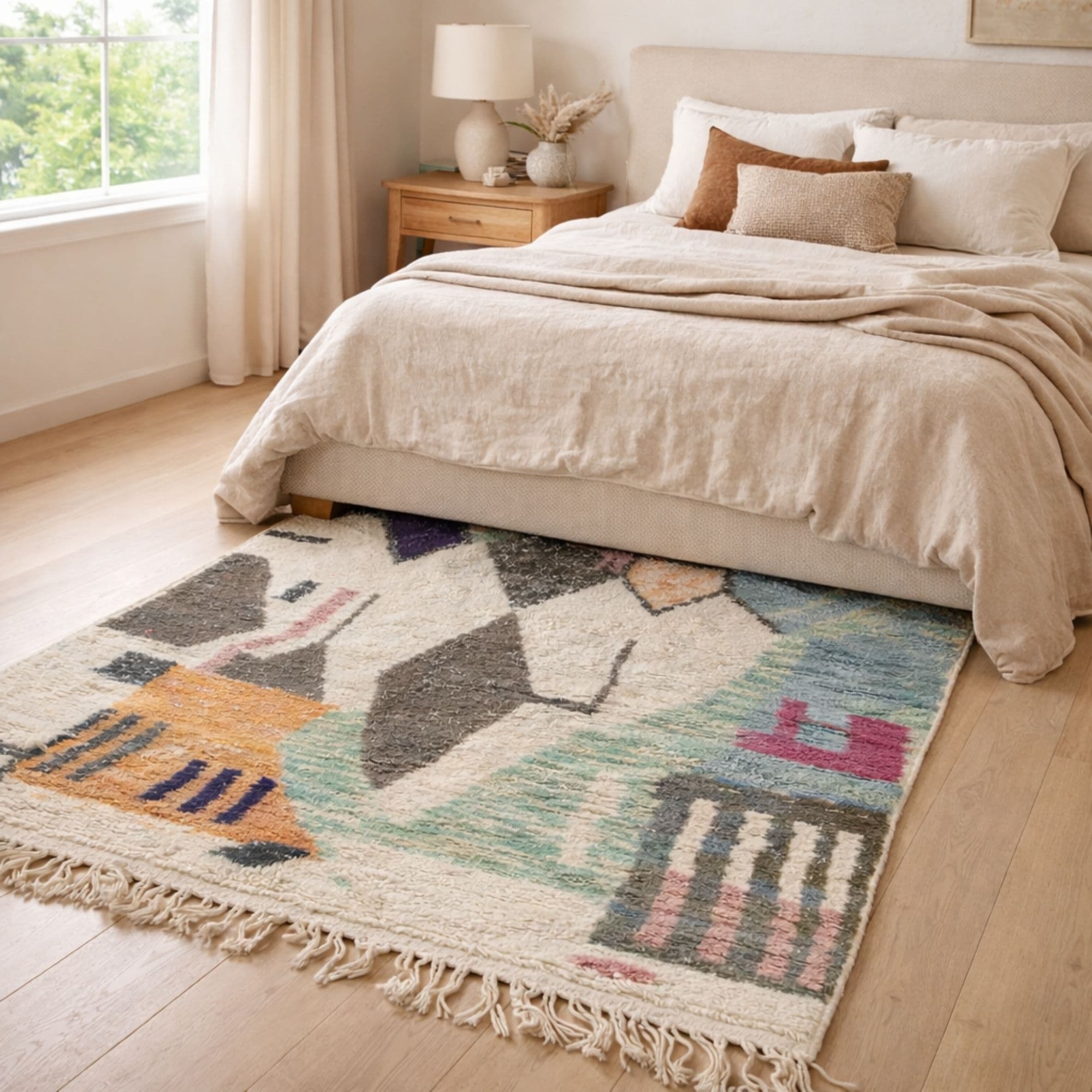
When these former nomads were forced to settle and natural wool became scarce, the women did not rely on a nameless, ancient collective instinct. Individual women made the radical, avant-garde choice to begin purchasing second-hand sweaters, unraveling the synthetic yarn, and weaving wildly abstract, intensely colorful modern carpets.
These compositions were free of any stylistic constraints, revealing a rare freedom of expression and personal interpretation. The weaver's choice to seek inspiration or forge an entirely new, asymmetrical neon pattern revealed her inner character and her specific frame of mind at that exact moment in time.
These women are not anonymous ghosts of the desert. They are Mina Badi, Touda Boumrour, Mama Boumshoul, Aïcha Marouche, Fatima Oujil, Rquiah Sagaoui, and Ito Taouacht. They wear their names with unabashed pride, like ornamental plumes. They are the founding designers of a tribal aesthetic that is now coveted by the world's most elite interior architects.
The Solitude of the Studio
When an Amazigh woman sits at her loom—often weaving in the quiet corners of her earthen home while her children sleep—she operates with the exact same intention as a painter in a Parisian atelier.
She feels her way around the colors, she questions the geometry, she experiments with tension and texture, and then she thrusts what has been produced into an arena where others will judge it. The fact that her canvas is made of wool and her studio is a nomadic tent or a rural kasbah does not diminish the intellectual rigor of her work.
The sides of a ceramic pitcher, the curve of a woven mat, the staggering abstraction of a Boujad rug—these are events that surpass simple ethnographic categorization. They are the materialization of a life lived, a silent, joyful, and selfless manual genius that requires no assistance.
Curating with Reverence
At Nomadinas, our sourcing philosophy is built entirely on reverence for the artist. We do not view Moroccan rugs as interchangeable commodities. We understand that every knot tied, every subtle shift in dye (abrash), and every deliberate asymmetry is the signature of a master.
When you bring one of our vintage or heritage-crafted rugs into your luxury interior, you are doing more than elevating your architecture. You are acknowledging the brilliant woman who made it. You are rejecting the 19th-century myth of the anonymous tribal craft, and inviting the true, named soul of Moroccan artistry to anchor your home.